- Published on
BYD is the first manufacturer to accept liability for accidents with driver assistance
- Authors

- Name
- aimode.news
- @aimode_news
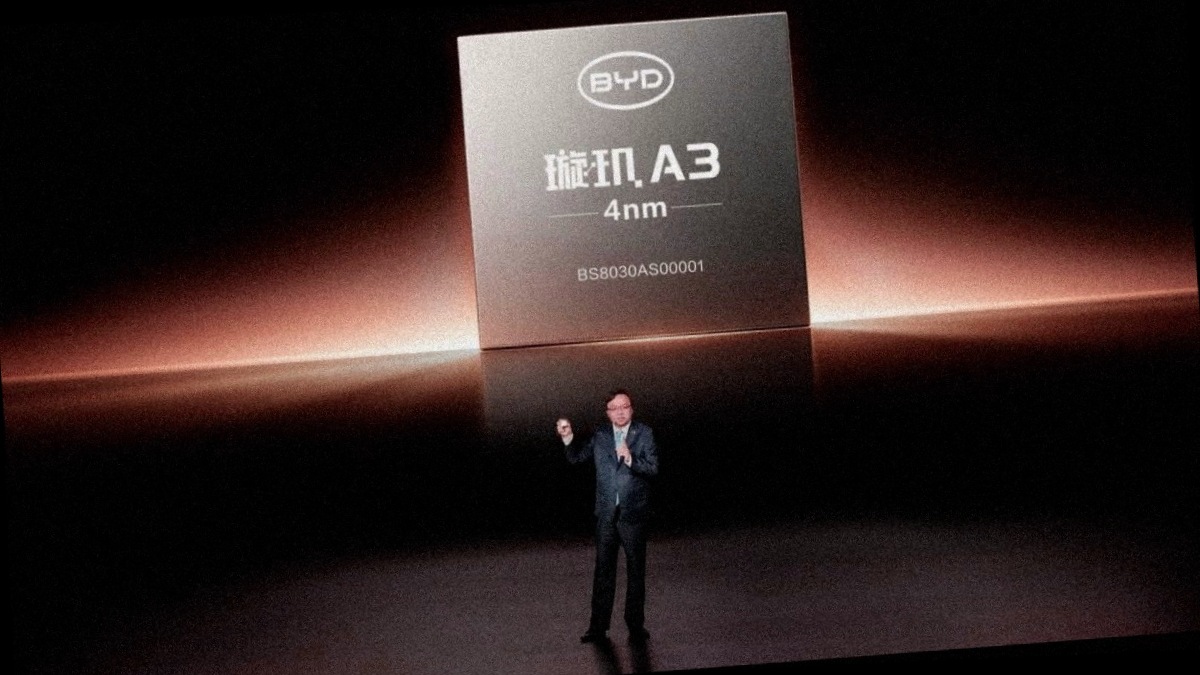
The Chinese car manufacturer BYD assumes full financial liability in China for accidents that occur when using its urban driving assistance function Urban NOA. The unique commitment in the industry is valid for one year from vehicle delivery or from the date on which existing customers update to version 5.0 of the “God’s Eye”-LiDAR system via OTA update. At the same time, BYD presented with the XUANJI A3 a self-developed 4-nanometer chip for the autonomous driving functions, which will enable assistance at levels 3 and 4 in the future.
As BYD explains in his press release, the commitment covers all economic damages arising from a legally relevant accident, provided that the Urban NOA function was active and was used in compliance with the rules. Specifically, repairs on your own vehicle, material damage by third parties and personal injury, including medical costs. There is no ceiling for the refund according to BYD. Customers also do not have to complete separate insurance for driving assistance, and a case of damage should not increase the regular car insurance premium in the following year.
Acceptance of liability increases use
The offer applies exclusively to China and only to versions A and B of the God's Eye system. BYD speaks of a “double guarantee”. Prior to that, the Group had given a liability statement for its parking functions classified as Level 4. According to company data, the rate of use of the automatic parking function increased from 21 to 93 percent after this guarantee was introduced, a clear indication of how strong liability transparency affects the acceptance of automated systems.
Video by heise
Details on the exact conditions remain vague. BYD applies the payment to a “regular use” of the function and a legal liability statement. The way in which the evidence is conducted in the event of damage is concrete, such as whether the manufacturer's driving log data is considered to be sole proof or independent expert access is not disclosed. Technically, BYD has an extensive data base with more than 3.15 million connected vehicles and a daily recording of more than 200 million kilometres of driving. The God's Eye system logs sensor status, driver interactions and activation states. To date, BYD has not published a legally formulated policy with exclusions, regression regulations or provisions on gross negligence.
Price struggle for driving assistance
In direct comparison with the competition, BYD focuses on aggressive pricing policy: The God's Eye package costs around 12,000 yuan (approximately over 1500 euros) in China as a one-time payment including the liability statement. Teslas “Assisted Driving” is located in China at about 64,000 yuan (about 8100 euros), Huawei’s ADS Max at 36,000 yuan (approximately 4600 euros). None of the competitors offer a comparable manufacturer liability for accidents in assisted driving. Tesla continues to emphasise the driver's supervision, Nio and Xpeng rely on optional additional insurance for a few hundred yuan a year.
Functionally, God's Eye plays with City-NOA, traffic light detection, automated parking and optional Lidar in the same league as Teslas FSD, Huawei's ADS Max and the NOA systems from Nio and Xpeng. BYD focuses on a combination of camera, radar and lidar sensors as well as a central computing platform, while Tesla continues to rely exclusively on cameras for visible light. Mercedes' Drive Pilot is the only system in Europe and the USA that is actually approved as Level 3, but is limited to motorway scenarios up to 60 km/h and thus to a significantly narrower range of applications than BYD's city assistance.
Own 4-nm chip for Level 3 and 4
BYD presented China's first mass-produced 4-nm chip with the XUANJI A3 according to its own specifications. A single chip delivers around 700 TOPS computing power; in a three-chip configuration, the system reaches about 2100 TOPS. The energy consumption per TOPS should be around 20 percent below the comparable solutions. BYD plans to offer God's Eye – including the Lidar variant – optionally for the entire model range, down to the Seagull entry model for around 69,800 yuan (approximately 8900 euros).
According to BYD, the chip is designed for level 3 and 4 driving functions. Among other things, a more stable City-NOA with complex intersection logic, more automated highway driving with “hands-off” phases in defined zones as well as extended valet parking functions are planned. However, these are only roadmap targets so far: China has approved 2025 first pilot programs for level 3 autonomy, BYD is one of the manufacturers with corresponding test licenses in cities such as Shenzhen. A comprehensive series release for level 3 or even 4 is still pending. In everyday life, buyers are currently receiving a system at Level 2+, supplemented by an exceptionally broad liability promise.
Transfer to Europe
For the European market, the BYD lifting model is currently not announced. In the EU, with UNECE regulations such as R157 for automated track-holding systems, strict conditions of approval are applied which limit level 3 functions to closely defined operating areas. BYD’s data-intensive “Data Flywheel”, a continuous recording and evaluation of real driving data for AI improvement, would also have to be configured in the EU GDPR-compliant. A direct transfer of the Chinese model therefore appears unlikely. For the industry, BYD still sets a signal: If you apply your driving assistance as safe enough for city traffic, you will have to ask why it does not pay for their mistakes.
(fpi)