- Published on
Chips, chips... boom? South Korean technology manufacturers have joined the trillion-dollar club, but some fear a short-circuit may occur.
- Authors

- Name
- aimode.news
- @aimode_news
South Korea has overtaken India to become the world's sixth-largest stock market, leaving the stock markets of the United Kingdom, Germany and France lagging behind. But despite this meteoric success, some worry that the Kospi index is too dependent on two newly minted, trillion-dollar chipmaking companies.
Chip company SK Hynix last week claimed a seat in Asia's club of billion-dollar companies, alongside fellow South Korean Samsung Electronics and Taiwan's TSMC. Explosive demand for chips used in AI has propelled the trio beyond the valuation threshold.
SK Hynix's stock price has soared 1,000% over the past year, while Samsung's has soared 500%. Thanks to the meteoric rise of these chipmakers, the South Korean stock market has experienced meteoric growth since the end of 2025, breaking record after record.
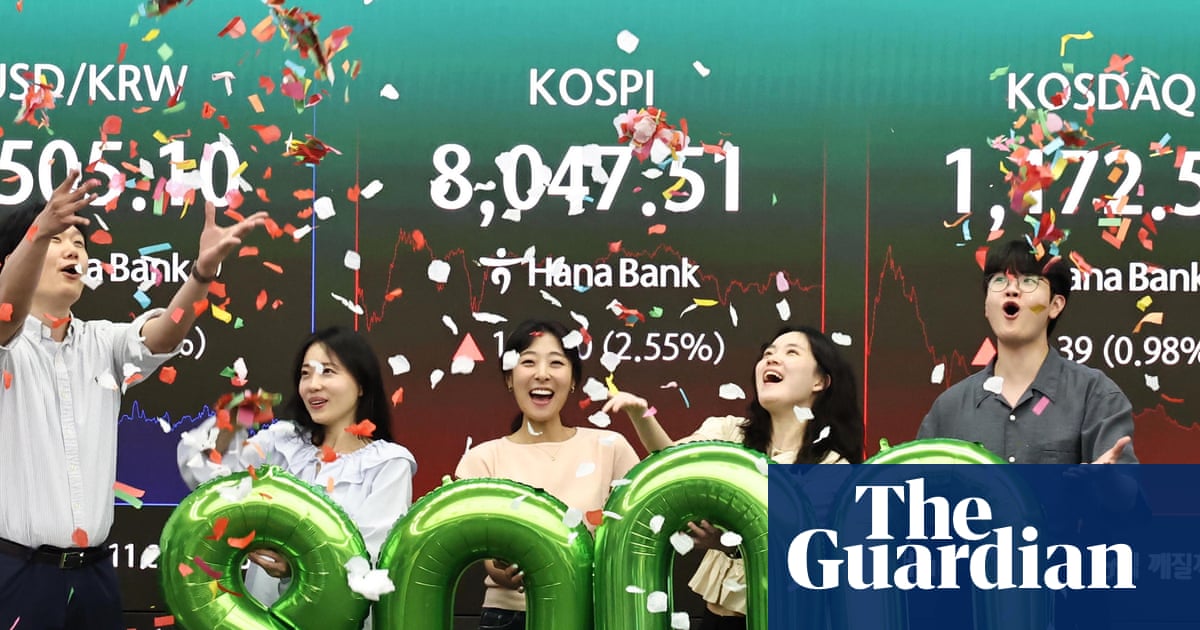
The Kospi index hit an all-time high of 8,880 this week, capping a 220% rise in 12 months. Goldman Sachs predicted further gains. It raised its 12-month Kospi target to 9,000, in what the investment bank called a "once-in-a-generation surge" in semiconductor earnings. In a shake-up of the global pecking order, the stock markets of South Korea and Taiwan surged above India.
“I'm watching this in Seoul, and I still have to pinch myself,” said Peter Kim, global investment strategist at KB Securities, as South Korea became the first country other than the United States to have more than one company worth at least $1 trillion. “Koreans are certainly excited about this idea. »
Japan, too, is benefiting from the AI boom.
Tokyo's Nikkei 225 index hit an all-time high on Monday as investors continued to flock to AI and semiconductor-related stocks. Amid the money moves, auto giant Toyota lost its crown as Japan's most valuable publicly traded company, toppled by SoftBank Group, an investment firm heavily focused on AI technology.
Kim says a “radical change” is underway. After 20 years of investing in platforms like Alphabet, Amazon and Meta, transforming tech start-ups into some of the biggest companies on the planet, the money is moving into hardware.
Until recently, chipmakers had limited investment appeal, Kim says, with companies producing "relatively flat and uninspiring demand." But the rise of AI and its massive thirst for chips has created an “astonishing reversion.”
Nvidia, the world's largest $5 trillion company, sits at the center of the AI ecosystem. Production of its chips is outsourced to TSMC in Taiwan, which became the first company in Asia to reach the $1 trillion mark.
Nvidia CEO Jensen Huang visited Taiwan in late May and made a number of optimistic statements, including plans to invest $150 billion a year in Taiwan, which he considers the "epicenter" of the AI revolution.
“Taiwan is booming,” Huang said. “That’s where the chips come from, the packaging comes from, that’s where the systems are made, that’s where the AI supercomputers were created.” In Taipei, Huang met with senior South Korean technology executives and is scheduled to fly to South Korea this week.
But the rapid rise in technology stocks has sparked fears of an AI bubble.
AI has a voracious demand for memory chips – which serve a different function than Nvidia's advanced chips. The three companies meeting this demand are Samsung, SK Hynix and US chipmaker Micron, itself recently added to the $1 trillion club.
Russ Mould, investment director at AJ Bell, warns that the share prices of these three chipmakers bear similarities to those of some companies in 2000, just as the tech bubble was about to burst.
The chip industry has a reputation for being volatile and experiencing boom and bust cycles. But Mold says those cycles are behind us, “thanks to the demand for AI.”
Kim agrees. He says demand, at least for now, appears to be supported by Meta, Amazon, Alphabet, Microsoft, a group he calls "AI hyperscalers," who have "so much money" and "so much commitment to this AI project."
But Kim says his company's research indicates that Samsung and SK Hynix contributed as much as 70% to the Kospi's growth in 2026. The polarization of the South Korean bull market is unprecedented, he says.
Such focus leaves Kospi highly exposed to the global AI spending cycle or supply chain issues.
Ipek Ozkardeskaya, senior analyst at Swissquote, noted that the Kospi VIX, a volatility index, reached “an exceptionally high level” of 75 this week – historically, the index hovers around 20, she wrote in a market note.
That's unusual because the VIX typically rises during big sell-offs in equity markets - not when stocks are rising, Ozkardeskaya said.
“The rise in the VIX, alongside the historic rally in the Kospi, shows that investors today are buying more in panic, for fear of missing out on something important.”
Kim says another shift is happening in global markets. Traditional institutional investors have long believed that the United States has the biggest, smartest and biggest companies, he says, and that "Asia is there to pick up the leftovers."
“I feel like the feeling has changed.”