- Published on
Humanoid robots are 'the future' of car manufacturing, says BMW
- Authors

- Name
- aimode.news
- @aimode_news
According to BMW, humanoid robots are “the future” of automotive engineering
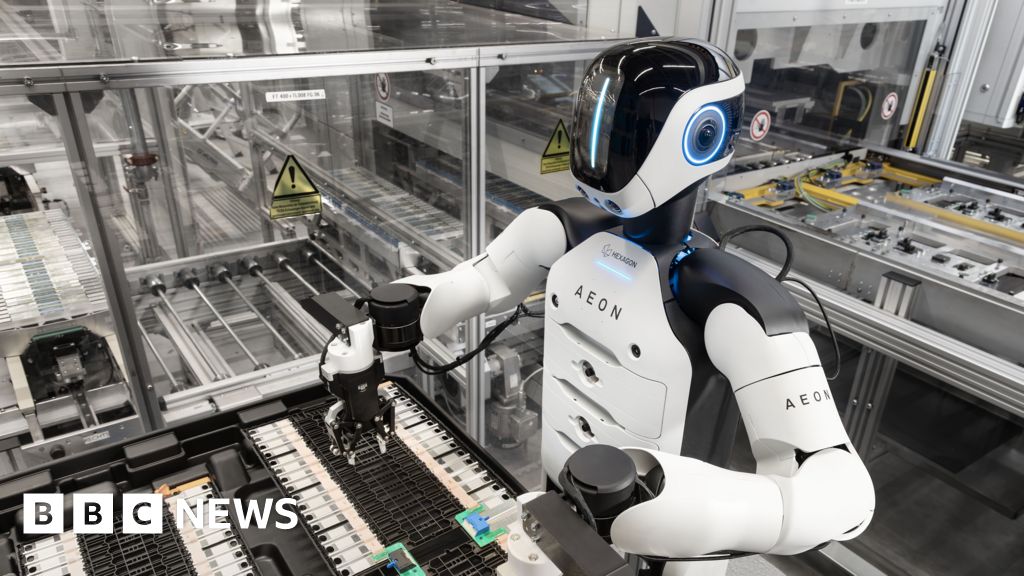
For the first time, BMW will use humanoid robots for automotive production in Europe. From summer onwards, two robots from Hexagon Robotics will work in production. They are currently in the test work in Leipzig. “This will be the future of automotive production,” says Michael Nikolaides, Head of Process Management and Digitization at BMW. Robotic arms and other automation systems have been used in the automotive industry for decades. So why the transition to humanly shaped robots? “If you have a humanoid form, you can use it practically at any workplace where a person works today because it has the same size and the same skills,” says Nikolaides. The cost of robots has fallen, while the redesign of the assembly line is still expensive. This makes it more cost-effective to use robots that fit into existing human processes. “If a robot costs 17 million, you would reorganise your factory around the robot, but this is no longer the case,” says Bill Ray, a prestigious VP analyst at Gartner. “Now you want to integrate it into your existing work.”
The hexagon robot with the name Aeon has the shape of a human, is 1.65 m tall and weighs 60 kg. They have a maximum speed of 2.4 m/second and can carry for a short time 15 kg or permanently 8 kg. Aeon is equipped with 21 sensors, including cameras, radar, a microphone and force and torque sensors for manipulation. At BMW, the robots were developed using a combination of teleoperation (sensors on humans) and simulation in a digital twin of the factory with software from Nvidia trained. The robot in the simulation got a task and simulated it repeatedly to identify the most promising solutions, an approach called Reinforcement Learning. Teleoperation was used for tasks such as taking up a part, so that the physical robot could learn the different ways that a person performs this task. The training of robots continues rapidly – the faster you can train a robot, the better. One of the most exciting aspects of the use of AI in the physical world (physical AI) is the imitation learning, says Arnaud Robert, President of Robotics at Hexagon. Here, the robot learns how to do a task by watching how the task is done, either using videos from different angles of view or using human motion sensors. Robert says that imitation learners can shorten the time needed to train the robot from months to days. “The best translation [from man to robot] is if teachers and pupils have the same form factor.”
So could the robot just look at someone at the box-packing and then join? “This is the ultimate scenario,” says Robert. “They probably describe something that is one or two years ago.”
Ray von Gartner estimates that a robot will be able to follow simple language instructions within three to five years to perform a task effectively. Aeon has only a battery life of three hours, but one layer lasts eight hours, so that the robot is designed to replace its own battery in about three minutes, including the arrival and departure to the charging station. The tasks of the robots at BMW will be to supply parts of production tools and to take over pick-and-place tasks for battery assembly. Although the robots are multifunctional, they like factory workers are not expected to change their tasks frequently. Nikolaides says that robots have the potential to help with repetitive or physically demanding work and also to overcome a lack of labour. “We know that in a few years there will be a lack of personnel and help humanized robots,” says Nikolaides. “When we automated production of cars in the 1970s, everyone said that this would lead to many job losses, but the opposite was the case,” he says. “Through this new technology, new jobs were created, and so we see [humanoid robots].”
Other automotive manufacturers are also very interested in modern robotics. Toyota, for example, plans to use humanoid Digit robots from Agility Robotics after a successful test. The Chinese company Xiaomi has tested two of its own humanoid robots in the production of electric vehicles. BMW has already gained some experience with humanoid robots in Spartanburg, USA, where the figure O2 robot helped build 30,000 vehicles from the X3 model. It worked at the same pace as a person. An observation from the United States was that AI-based robots with variance are much better suited than previous machines. “If a standardized industrial robot would change the position of the sheet a little or shift it or tilt it, one would have a failure,” says Nikolaides. “These humanoid robots can analyze this and will simply continue working.”
An essential difference between the Figure and Aeon robots is that figure runs, but Aeon has wheels instead of feet. “In a workshop it makes more sense to have wheels because Aeon can roll from one place to another,” says Nikolaides. BMW also used a Boston Dynamics Spot robot in the form of a dog as a maintenance monitor. “He had to run stairs,” says Nikolaides. “He could go to the basement where many machines stood.”
The robots were welcomed by the employees, says Nikolaides. He imagines that people will give them names as they have done for older non-humanoid robots. “If there is no name, it’s a machine,” says Ray von Gartner. “If it makes a mistake, it is broken. If it has a name, people expect it to make mistakes. People forgive it. One of the things we tell companies is to give their robots names.”
Aeon has no human face, but has a display area on the front of his head, which displays symbols, for example a line when performing a task and a circle when listening. “We are still working on this [visual language], but we are firmly convinced that Aeon must convey signals in a natural way for the human being,” says Robert. Humanoid robots begin to keep up with people at work, but Ray believes that the robots have been overvalued, especially in public demonstrations. “The main application for a humanoid robot is to go on stage and artificially raise the share price,” he says. “Danceling robots or whatever: this is not so difficult.”
It is the risk that people overestimate the capabilities of a robot, he says. “If you see a humanoid robot running, assume that it can race, climb or jump. He can't do it, but your brain fills these gaps. We have unrealistic expectations when people use these robots.”