- Published on
I must have the Anker SOLIX S2000. This is the most efficient small power station
- Authors

- Name
- aimode.news
- @aimode_news
I saw several hundred zlotys rotting in the fridge. In the form of vegetables, meat, dairy products. What hurt the most was the thawed portions in the freezer pocket. Terrible smell. I was only gone for the weekend, but that's enough for the summer. Everything had to be thrown away. A general cleaning and airing of the house was planned. A few days later I bought my first power station.
Initially, the power station was intended to serve as an alternative source of energy for key home appliances. The holiday home is connected to an old installation that tends to fail when you least expect it. It's the end of the world, right next to a beautiful forest, no service technician can get there in an hour. Sometimes he calls to say he won't arrive at all, for example due to weather conditions. Asphalt? Ha, that's fine.
I quickly discovered that the station can be not only a security device, but also a wonderful, although heavy, power bank
I started powering a projector in the garden from it, projecting a 100-inch-plus image onto the barn wall. In the allotment garden, we powered the TV and the console from the station, of course at the same time. A few hours of outdoor fun, no fiddling with cables. I also connected a reciprocating saw to the station, getting rid of the stumps that I had been unsuccessfully fighting with an ax for years.
Now relatively small, handy, portable power stations are one of my side hustles. I read about them, follow the industry and fantasize about one day setting up for a few days with such a unit, solar panels and a tent somewhere near Yellowstone. Or the Grand Canyon. What is it like to throw a 16-kilogram station onto the bed of a car? I regularly carried similarly heavy electric scooters down from the 2nd floor.
From this perspective, the Anker SOLIX S2000 looks like a dream come true. There has never been such an efficient, small and light station
SOLIX S2000 is a storage unit with a capacity of 2010 Wh with an output power of 1500W and a peak power of up to 3000W. These types of stations don't offer much power, but Anker introduces a small revolution here: their storage consumes only 6W in standby mode, which translates into up to 1/5 longer operation. For example, the S2000 is supposed to power an average refrigerator for up to 35 hours, compared to 22 - 25 hours for the competition.
Anker SOLIX S2000 can also power other devices while charging its own batteries (pass through) from the network or solar panels up to 400W. The station is also equipped with a UPS mode, automatically taking over the load from the network in less than 20 ms. Most TVs, air conditioners and refrigerators should not have time to turn off.
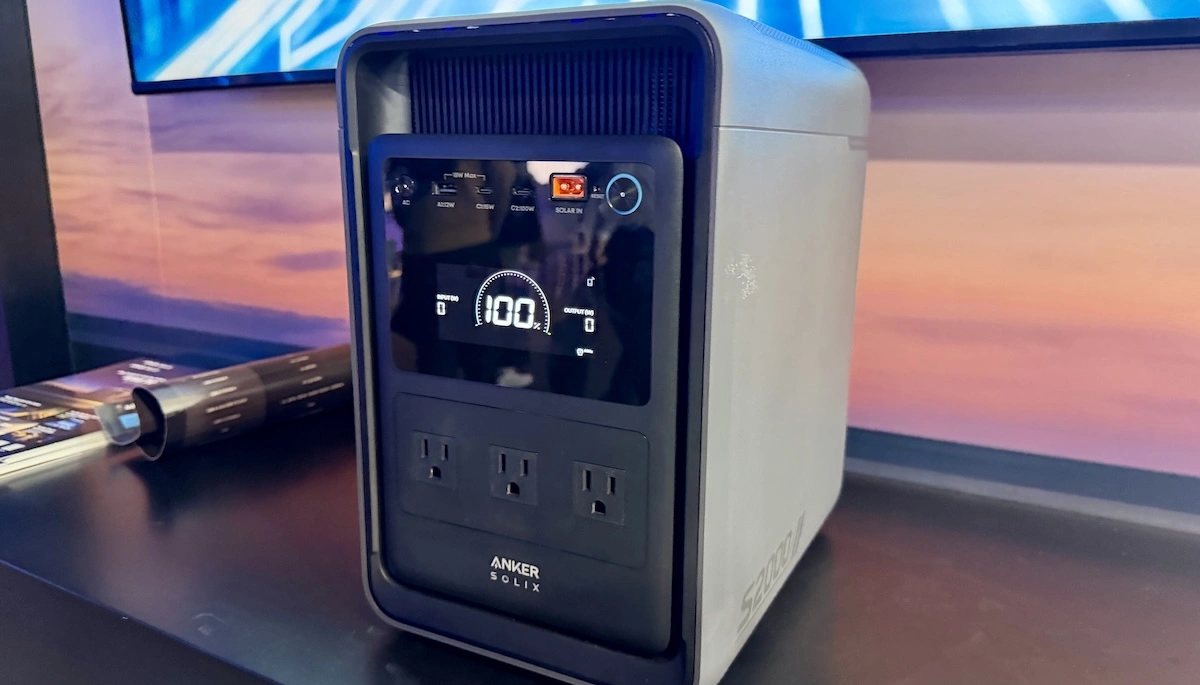
And these ports and sockets! Anker SOLIX S2000 has three power sockets on the front and two on the back (five in total). Well laid out to avoid cable tangles. In addition, there are powered USB ports: USB-A 12W, USB-C 15W and USB-C 100W. There is also a solar input and an AC socket that replenishes 80% of the battery in 80 minutes. Easy to remember. With this collection of ports, you can simultaneously power not only a refrigerator, but also several other key devices: a lamp, a TV, a laptop or smartphones.
However, what appeals to me the most is its dimensions. Anker SOLIX S2000 is so handy that you can't just carry it around
Anker boasts that their latest device is 30% smaller and 25% lighter than the competition. We are dealing with a station weighing just over 16 kg, 32 cm high, 28 cm long and 21 cm wide. In terms of volume, it is like a pack of mineral water. Or a cabin bag for the plane.
- Height: 32.3 cm
- Length: 28.2 cm
- Width: 20.8 cm
- Weight: 16.2 kg
In my mind's eye I can see myself taking such equipment out of the shed, moving it to the garden, putting it on the table, and then connecting the TV and console to it. I can squeeze out 5 hours of fun in Mario Kart World. Possibly much more. In turn, high efficiency means that, combined with the panels and good weather, the Anker SOLIX S2000 is basically independent, allowing for long weekend camping or fishing trips. All with one piece of equipment the size of a large microwave.
The design itself is also okay. The durability of the device is also impressive
Lithium-iron-phosphate LiFePO4 batteries provide, according to the manufacturer, approximately 10,000 charging cycles. According to Anker, this is close to 15 years of use. This means that we have equipment that will last well over a decade of intensive use. In addition, one that does not require any special place to operate. The vertical, free-standing case in the shape of a small PC will easily fit on any wall, on any table, even on a chair. With these dimensions, we can also place the S2000 on a kitchen counter, if necessary.
In turn, a glance at the screen on the front of the housing is enough to gain insight into the three most important parameters: the station's charge level, output power and input power. Thanks to this information, we know how resource-consuming the connected devices are, how efficient the photovoltaic panels are (if we use them) and how many operating hours (approximately) we have left. More advanced settings are available in the smartphone application.
Best of all, the Anker SOLIX S2000 will be extremely affordable. At least that's what it looks like
The pre-release price of the Anker SOLIX S2000 station is $679. Let's add taxes and the result is plus or minus PLN 3,500. The rate is very beneficial. Too advantageous. Branded competition in the 2000 Wh segment is almost twice as expensive. Anker creates quality products, especially in the power segment, so I still find it hard to believe this launch price. Even with the press release in front of me.
If nothing changes, it will be a safe purchase. In spring and autumn to the garden, in summer to the holiday house. Additionally, it protects key home equipment all year round. Not everyone realizes this, but only 4 hours without electricity is enough for the temperature inside the refrigerator to start to rise quickly. I learned this the hard way (and expensively).