- Published on
iPhone 18: don't wait for the standard model, here's why
- Authors

- Name
- aimode.news
- @aimode_news
For the first time in more than ten years, Apple will not release its entry-level iPhone in the fall. This is not a calendar detail, it is a signal.
The leaks converge, and they do not come from anonymous accounts: Ming-Chi Kuo, Nikkei, Bloomberg, The Information. The storyline is now consistent from one source to another. In September 2026, Apple would present the iPhone 18 Pro, the iPhone 18 Pro Max and its first foldable iPhone, according to these sources. The “standard” iPhone 18 would not arrive until spring 2027, undoubtedly accompanied by an iPhone 18e and a second generation iPhone Air.
The consequence would be simple to formulate. The iPhone 17 would remain the last non-Pro iPhone in the catalog for more than eighteen months. Apple has never skipped an entire calendar year on its best-selling lineup before.
What this report really says
I don't believe for a second that it was an industrial accident. Apple divides its range into two windows, and each window responds to a specific problem.
The first would be the cost of the components. RAM and storage have been soaring for months, driven by the needs of the AI industry and its data centers. Apple has obviously chosen to concentrate its supplies where they make the most money: the foldable and the Pro models. The standard, lower-margin model would wait its turn.
The second is rhythm. By spreading its launches over two highlights per year, Apple offers itself twice as many opportunities to occupy the field. This is a direct response to Android, which floods the market with high-end smartphones all year long while Apple was content with a single September keynote.
The third, more prosaic, is logistics. A range that stretches, folds, Air, Pro, e, and the old models still on sale, becomes impossible to launch all at once. Apple smooths its production.
None of this works in your favor if you're waiting for an affordable iPhone. You are not the priority on this calendar. The foldable one is.
Why waiting makes no sense
Let’s take a hard look at what you buy today. The iPhone 17 starts at €979 in 256 GB, the price of last year's iPhone 16... for twice the storage. Apple has held its prices where most manufacturers have started to raise them.
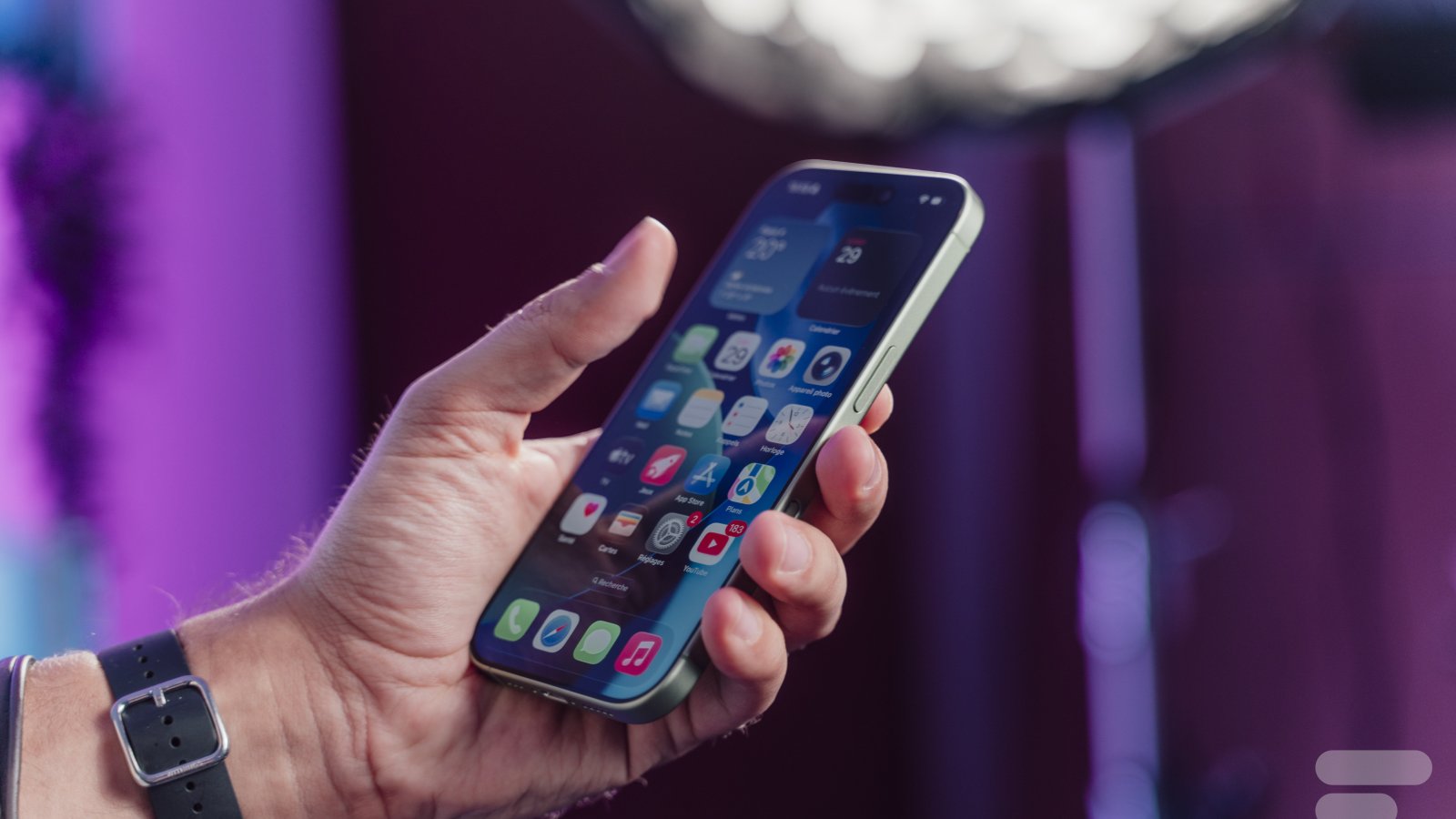
And the record doesn’t just have to be correct. This iPhone 17 inherits almost everything that made the Pro valuable: 6.3-inch screen, ProMotion 120 Hz, 3,000 nits, always-on display, A19 chip, dual 48-megapixel sensor on the back, 18-megapixel front camera, and wired charging which increases to 40 W (50% in 20 minutes announced by Apple). Two years ago, half of this list was reserved for models costing more than €1,300.
There remains a useful benchmark on the software side: Apple guarantees seven years of iOS updates on the iPhone 17, i.e. monitoring guaranteed until 2032. Enough to put into perspective the idea that buying “the old model” would be a bad calculation over time.
Now the standard iPhone 18. Even if it were released tomorrow, the leaks do not announce a breakthrough: it would feature an A20 chip engraved in 2 nm, 12 GB of RAM, a new C2 modem and photo sensors from Samsung. Real progress, but incremental. And above all, nothing would guarantee that it would escape the increase in prices that the entire market is experiencing.
So let’s ask the question right side up. Why wait a year for a marginal gain, at a price that is at best identical, at worst higher? I don't see a rational answer.
If your budget is tighter, the iPhone 17e meets 95% of needs for €749. Same A19 chip as the iPhone 17, same 256 GB, same ecosystem. You lose 120 Hz and a second rear sensor. That's all.
The real reserve is AI and it concerns us more than anywhere else
There is one point on which I refuse to give free advertising to Apple: Apple Intelligence. The new generation Siri, the one that the firm has been promoting for months, has already been postponed once. The marketing promise always runs faster than the product.
And in Europe, it’s a double punishment. Several functions arrive here late, while Apple and Brussels agree on the DMA. If you buy an iPhone today with a bet on AI, you're buying a promise, not a feature.
A quick reminder to situate the issue: the DMA (Digital Markets Act) is the European regulation on digital markets. It is he who forces Apple to open certain parts of iOS, and therefore to negotiate the deployment of several functions, including Apple Intelligence bricks, before activating them in Europe.
My advice is in one sentence: buy this iPhone for what it does now, not for what Apple promises you will do later. And on this criterion, the iPhone 17 is quite simply the best buy in the range.
So no, don't wait for the iPhone 18. Apple, clearly, is putting its schedule ahead of yours.