- Published on
Is 007 First Light playable in cloud gaming? Here is our test
- Authors

- Name
- aimode.news
- @aimode_news
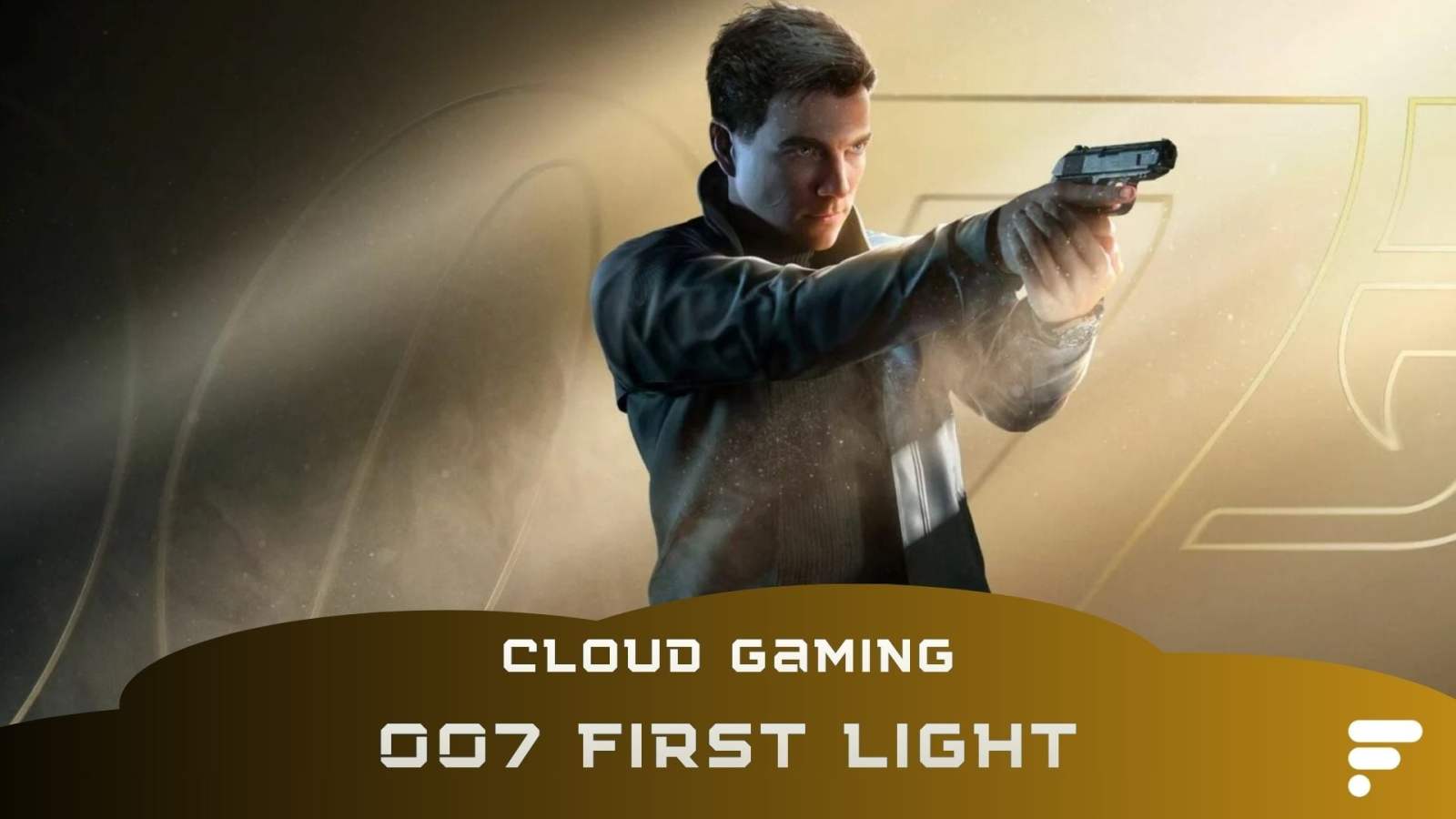
A James Bond game has been in the works for several years and here it is finally! Developed and published by the IO Interactive teams, 007 First Light turns out to be a delicious mix of Hitman and Uncharted. More than that, it is above all a love letter to fans of Fleming's work and new proof that James Bond can still live with the times with this original scenario mixing artificial intelligence, geopolitical tensions and quantum technology.
007 First Light has been available since May 27 on Windows, PlayStation 5, Xbox Series and should be released on Nintendo Switch 2 later in the year. For players without consoles and not enough RAM in their PC, the game is also available on cloud gaming platforms upon release. The game is magnificent and therefore demanding. You need no less than 32 GB of RAM and an RTX 5080 to play in Ultra mode (4K and +200 FPS with DLSS 4.5).
That's good, the Nvidia GeForce Now servers allow you to play as if you had an RTX 5080 on hand, up to 5K but with at best DLSS 4 for the moment. It remains to be seen whether 007 First Light in cloud gaming conditions is as pleasant to watch as a James Bond film in a Dolby Cinema room. Answer in this test.
Also read:
007 First Light: what configuration to play the new James Bond on PC?
Where to play 007 First Light in cloud gaming?
Upon release, 007 First Light is available on these cloud gaming platforms:
- Nvidia GeForce Now from the Performance plan at 10.99 euros per month (Purchase required on Steam, Epic Games Store and Xbox Store – compatible with RTX 5080 servers);
- Xbox Cloud Gaming from the Game Pass Essential plan from 8.99 euros per month (Purchase of the game required on the Xbox Store);
- Shadow from the Neo plan at 32.99 euros per month (Purchase of the game required on any store);
- Boosteroid from the Ultra plan at 7.49 euros per month (Purchase of the game required on Steam).
Also read:
Cloud gaming: what are the best streaming game services in 2026?
Our test of 007 First Light in cloud gaming
For this article, we tested 007 First Light in cloud gaming with the Nvidia GeForce Now Ultimate formula in several configurations. First of all, on a MacBook Air M3 connected to optical fiber and the graphics configurations pushed to the maximum. Then, with a Steam Deck OLED connected to Wi-Fi, and finally, with a smartphone connected to 5G to see if the game can hold up on a less stable network.
Also read:
007 First Light: why the game angers owners of AMD graphics cards
MacBook Air M3 + 1 Gb/s optical fiber
If a MacBook Air cannot under any circumstances, or with great difficulty, run 007 First Light locally, cloud gaming allows a server to do it for it. Between the RTX 5080 server and the fiber optic connection, there is enough to have fun with the configuration:
- Resolution: 5120 x 2880 (5K)
- Super Resolution DLSS: Ultra Performance Mode
- DLSS image generation: 6x
- Texture quality: Ultra
- Texture filtering: Anisotropic x16
- Level of details: Ultra
- Terrain quality: Ultra
- Shadow quality: Ultra
- Volumetric fog quality: Ultra
- Quality of volumetric effects: Ultra
- Overall lighting quality: Ultra
- Quality of reflections: Ultra
- All post-processing effects enabled
All requiring more than 9 GB of VRAM.
Under these conditions, 007 First Light runs… normally. Considering the parameter requirements, it's actually quite good, although we've already seen better elsewhere. However, we deliberately chose this sequence of the game taking place in a nightclub with a multitude of light and shadow effects and many NPCs to load and animate. A lot of work for any graphics card.
During this mission, which actually lasted a little less than 30 minutes, the game averaged around 120 FPS. But that was until a sudden peak in latency. An incident that happens from time to time is the vagaries of telecoms, but since then, the game has lowered its ambitions to run at just over 100 FPS until the end of the sequence. However, no packet loss has been reported while the allocated bitrate and the share used have not changed.
The drop in FPS could, however, be desired by Nvidia GeForce Now in order to preserve perfectly regular frame pacing at the expense of raw performance. The algorithm would have responded by lowering the FPS in order to preserve the fluidity of the game, which was not actually impacted by it to the naked eye. The latency peak was the trigger for this response.
This rationalization of frame pacing dates from update 2.0.76 of GeForce Now dating from the end of 2025. Streaming at 120 FPS actually makes little sense if the game itself is running below this threshold. However, it is recommended to enable G-Sync in the game settings. This synchronizes the FPS of the video stream with the screen refresh rate to prevent stuttering and tearing.
Also read:
Already a visual slap on PC, 007 First Light is preparing a monumental graphics update for this summer
- Throughput up to 1 Gb/s
- 160 TV channels included
- Wi-Fi 5
- Throughput up to 8 Gb/s
- Without TV Player
- Wi-Fi 7
- Speed up to 5 Gb/s
- Without TV Player
- Wi-Fi 7
Steam Deck OLED + Wi-Fi
The Steam Deck OLED is back in stores but at a steep price. Gone are the days when you could afford a 1TB SSD with two or three RAM sticks for barely a hundred euros. If you were thinking of launching 007 First Light natively on the Steam Deck, it turns out that the game is quite well optimized if we stick to FSR's Balanced mode. But you shouldn't expect too much from the fluidity which oscillates around 45 FPS.
It's a completely different music with cloud gaming and an Ultra mode graphics configuration. The only differences with the previous session are the 3.5K resolution and the DLSS image generation here limited to x4. Obviously, with G-Sync activated, 007 First Light runs around 90 FPS here, which corresponds to the refresh rate of the Steam Deck OLED screen. On the other hand, no frame pacing this time despite a few latency peaks here and there. Normally, it is 5-6 ms.
007 First Light runs beautifully with the best graphics available and simple 5GHz Wi-Fi. You still need to have a perfectly stable network, otherwise, the slightest disturbance can lead to loss of packets and images given that buffering does not exist for cloud gaming. Which we did not fail to observe. But these micro-disturbances did not taint the gameplay.
Samsung Galaxy S26+ 5G
For our tests on a smartphone connected to the 5G network, this time we are using a Samsung Galaxy S26 (the S24 Ultra having suddenly given up the ghost). Consequently, the screen definition is lower, so for the occasion we chose Balanced mode in the GeForce Now settings with a resolution of 1680 x 720 pixels and a refresh rate capped at 60 FPS. Good for us.
With these settings, 007 First Light runs pretty well. The few graphic imperfections (which are not really noticeable on a 6.3-inch screen) are secondary here, the important thing is that the game is fluid throughout this session. The FPS hovers around 60 FPS and the latency between 20 and 25 ms, which, for a game like 007 First Light, is completely imperceptible, including during fight scenes.
Better yet, no latency peak was felt. This can be explained by two variables. First, the Balanced mode of GeForce Now which reduced the necessary bitrate, the latter was around 15 Mb/s on average while it easily exceeded 80 Mb/s on MacBook. Then, the 5G network here had what we were missing during our tests on Forza Horizon 6: stability.
Another advantage of this Balanced mode is the reduced consumption of mobile data. For 30 minutes of play, we only used 3.1 GB of data, so we're at just over 6 GB per hour. By comparison, an hour of streaming a film in 4K HDR on an SVoD platform consumes around 7 GB. In this specific case, cloud gaming on a smartphone is definitely worth it.
Oxygen 150 to 190 GB
- Unlimited calls
- 150 GB – 190 GB in France
- 32 GB in Europe
- Unlimited calls
- 130 GB in France
- 40 GB in Europe
150 GB
- Unlimited calls
- 150 GB in France
- 30 GB in Europe
Is 007 First Light playable in cloud gaming? Our Verdict
This edition of the cloud gaming barometer on 007 First Light was much more pleasant than the previous ones. Whether with optical fiber, Wi-Fi or 5G, the latest nugget from IO Interactive is perfectly playable. However, we remember that in the case of wireless networks, it is stability that takes precedence above all. Playing in busy locations with a saturated network is not recommended. There's also no point pushing the graphics to the max if the video stream then struggles to keep up.
Described as a demanding game, 007 First Light is above all suitably optimized. This barometer proves it on several occasions: the regularization of frame pacing on MacBook Air M3, when the flow went from 120 to 100 FPS without degrading the fluidity felt, and the Balanced mode of GeForce Now which makes it pleasant for sessions on a smartphone. Not to mention that this is one of the rare recent AAA games that works properly on Steam Deck, locally.
Conclusion ? License to play.
Also read:
Is Forza Horizon 6 playable in cloud gaming? Here is our test