- Published on
Less than €20,000, but impossible to open the hood: the risky bet of the electric Twingo
- Authors

- Name
- aimode.news
- @aimode_news
Updated article: Following the publication of this article, Renault France contacted us to tell us that the cause of the malfunctions experienced by Automobile Propre and Max BLD had been found.
The brand thus specifies that “the first analyzes have in fact highlighted the presence, in each case, of a personal diagnostic tool (“dongle”) permanently connected to the OBD socket, including when the vehicle is turned off and then put into standby mode. This is at this stage the only common element identified. This type of permanent connection disrupts the proper functioning of the vehicle, particularly that of the accessory battery. Users are also alerted to this in the instructions for use.
Renault also specifies that it has “encountered no similar situation either during our tests during the development of the vehicle, nor during tests carried out by other media” while “analyses are continuing in order to document all the potential causes of the situation. »
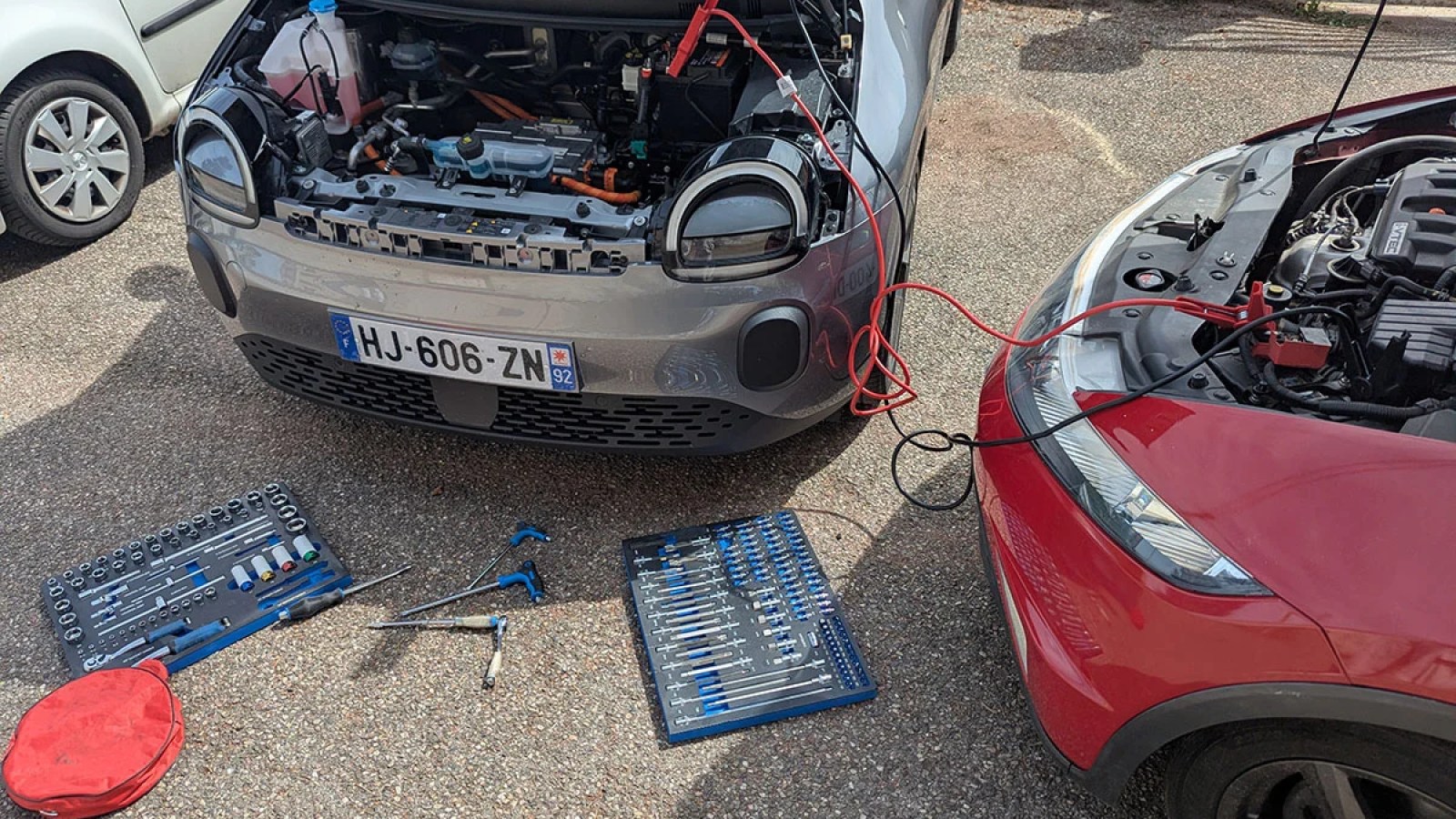
Original article: The scenario is enough to make one cringe: in the middle of an Automobile Propre test, the electric Twingo falls into electronic failure. The classic solution on a car? Cut the 12 volt battery to force a restart, the famous hard reset. Except that this battery lives under the hood. And the hood does not open easily.
It is this detail, innocuous on paper, which crystallizes a broader question. The new Twingo has been designed to become the cheapest electric car in France, under 20,000 euros excluding bonuses. To achieve this, Renault has taken many shortcuts. The real question: how long do these savings last before falling on the back of the customer?
A car designed “Chinese style”, in 21 months
Renault does not hide it, on the contrary. The Twingo E-Tech was developed in China in just 21 months, whereas a classic automobile project takes three to four years. This record pace makes it possible to reduce total costs by 20% compared to a conventional project. Concretely, we compressed everything: the design, but also the development and debugging, this phase where we track down bugs before release.
The result keeps its promises on the price side. The Twingo starts at 19,490 euros in the catalog, and falls below 16,000 euros with bonus deducted, or even below 14,000 euros for low-income households.
To achieve this, Renault has reduced diversity as much as possible: four colors, two finishes, a single engine-battery pair. The motor and the 27.5 kWh LFP battery come from China (it will soon be produced in France with Chinese technologies) to limit the bill.
A word on availability: the Twingo is assembled in Europe, in the historic Novo Mesto factory, in Slovenia, with marketing launching in early 2026 and the first deliveries expected in the spring. Enough to reassure after-sales service, the Renault France network managing warranty and spare parts.
And for those who find the bill still steep, we have calculated that the electric Twingo is not more expensive than the one from 1993, inflation included.
Where have the savings gone?
This is where it gets complicated. Three technical choices betray the logic of lower cost, and each has a concrete downside for the user. The Twingo abandons certain technologies compared to its big sister, the Renault 5.
First point: the LFP battery (lithium-iron-phosphate, a cheaper and more durable chemistry) is passively cooled, without an active liquid circuit, like the Zoé or the Volkswagen e-UP. In town, no problem. But on the highway, when rapid recharges follow one another, the cells heat up and the charging power can collapse depending on the conditions (speed and temperature).
During its test, Automobile Propre experienced a Paris-Lyon which dragged on because of what we call rapidgate: this restriction of the charge linked to heat, which leads to 15-80% in 55 minutes, compared to only 27 minutes during the first recharge. To get out of it, the tester had to limit his speed to 110 km/h while the temperature cooled down.
Of course, Renault defends itself by specifying that the car is not intended to be a motorway model, but still. Who has never come across a Twingo on the motorway for a long journey, especially driven by a young driver?
Second regression: the alternating current charger caps at 6.6 kW as standard. The old generation climbed to 22 kW thanks to the Caméléon charger, more than three times faster in theory (provided you have a three-phase terminal, which is still rare among individuals). Fast direct current charging is optional and costs 500 euros, while it comes standard on the R5 (except the top-price Five).
In other words, we pay less, but we also get fewer basic functions. It is this equation that pushes Renault to present the Twingo as the solution to relaunch affordable electric vehicles, provided that it accepts its limits of use.
The sealed hood and the youthful breakdowns
There remains the symbol: this hood which does not open without dedicated tools. Renault assumes, explaining that an electric car owner no longer has anything to maintain under the hood, neither oil change, nor belt, nor spark plug.
Removing the release cable, latch, and reinforced hinges yields a modest unit saving, but when multiplied by hundreds of thousands of units, it counts. This is claimed low-cost engineering.
The problem is when it breaks down. Automobile Propre experienced several electronic incidents during its test week, to the point of having to push the car to the side of the road. An isolated stroke of bad luck on a press copy?
Not only that: YouTuber MaxBLD experienced the same problem, and the second Twingo that a dealership lent him, identical to the customer models, ended up failing too, with faulty air conditioning.
Good news: the breakdown is not immobilizing, the car continues to drive. Bad news: it can happen at any time, and the average customer will not be able to open the cover to attempt a restart.
Renault thinks it has found the problem, which should not bother most owners: the presence of a dongle on the OBD socket to finely measure the car's data by journalists. But the OBD socket can also be used by the most curious to note their consumption or the health of the battery.
To go further
“At this price, we forgive the bugs”: the first feedback on the Citroën ë-C3
A team of engineers is already working on the subject. It is hoped that the problem can be fixed with an over-the-air software update. A story that makes us think of that of the Citroën ë-C3 from Stellantis, full of bugs in its early days, due to too rapid software development.
But even the Volkswagen ID.3 suffered the same fate, again due to software bugs and a rushed commercial release.
Let us point out that this problem around the OBD socket is independent of the other negative points of the Twingo (fast charging restricted depending on the context, hood which does not open, slow charging less rapid than the previous version).