- Published on
LPCAMM2 Memory Explained: The Memory That Finally Makes Thin PC RAM Repairable
- Authors

- Name
- aimode.news
- @aimode_news
For years, thin and light laptops have hidden an inglorious secret: their RAM is soldered to the motherboard. Impossible to change, impossible to increase. With the Laptop 13 Pro, Framework says it has found the solution, and has just explained behind the scenes in a technical post signed by its founder Nirav Patel. The name of the solution? The LPCAMM2.
This is an important subject, because the whole issue of repairability in a modern computer is at stake here. And incidentally, the kind of detail that can save you from buying an entire PC just because 16 GB is no longer enough.
What exactly is LPCAMM2?
To understand, we have to go back to two families in memory who each lived in their own corner for a long time. On the one hand, DDR, that of PCs and servers, designed to be modular: these are the famous SO-DIMM strips that you clip into a laptop. On the other hand, LPDDR (LP for Low Power), born for smartphones, is much more energy efficient. Its drawback: to work, it must be soldered very close to the processor. In the 2010s, this LPDDR arrived in thin laptops: better autonomy, but goodbye to the possibility of tinkering with your RAM.
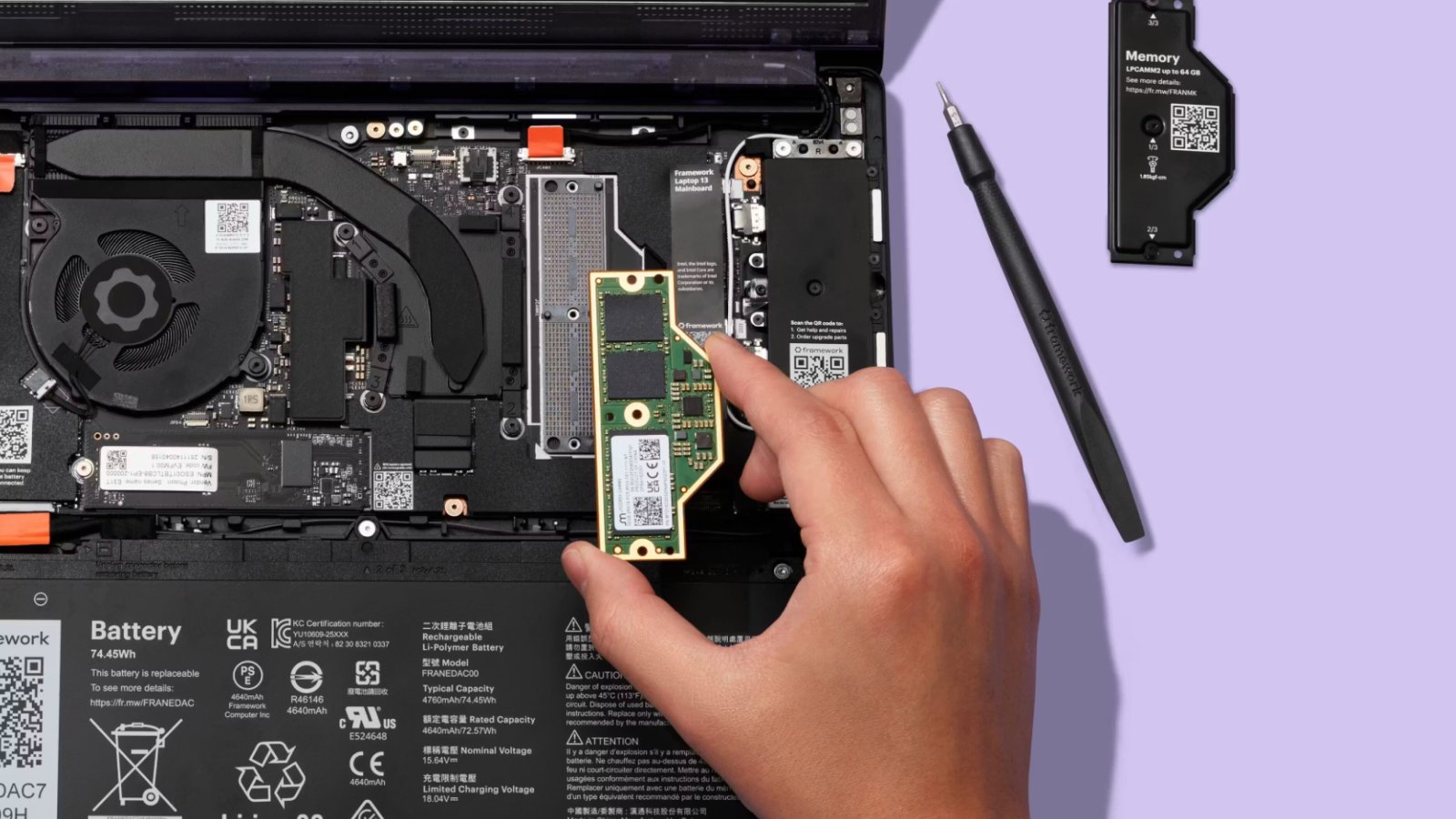
The LPCAMM2 (for Low Power Compression Attached Memory Module) serves precisely to reconcile the two worlds. The idea: take the same LPDDR5X chips that we would have soldered, and place them on a removable module which connects to the motherboard via a high-density compression system.
Concretely, we recover the sobriety of the mobile memory without losing the possibility of unscrewing it and replacing it. The standard, supported by the JEDEC organization which defines the industry's memory standards, descends from the CAMM format originally invented by Dell around DDR5.
For Framework, this is a topic. This is its third memory platform after DDR4 and DDR5, and its very first laptop to upgrade to LPDDR5X. The brand also specifies that the standard is so recent that it had to switch during development from an “E0” revision to the final “E1” version of the modules. In short, it’s all fresh.
Faster, more economical, but not at its maximum speed
On paper, the LPCAMM2 modules that Framework sells are rated to climb up to 8533 MT/s (megatransfers per second, the unit that measures memory throughput). Except that on the Laptop 13 Pro, they actually run at 7467 MT/s. The reason, given by Framework: pushing beyond that would require using a “crazy expensive” motherboard process. The processor-card pair therefore sets the pace, not the module itself.
This discrepancy has not gone unnoticed. On the brand's forum, users pointed out that the laptop's high-end Intel chips, the Core Ultra X7 and X9, are designed to climb much higher, and that capping it at 7467 MT/s could cost several percent of graphics performance. The table below puts the figures into perspective (Framework and JEDEC data).
| Criterion | SO-DIMM DDR5 | LPCAMM2 |
|---|---|---|
| Memory type | DDR5 | LPDDR5X |
| Speed on the Laptop 13 Pro | NC | 7467 MT/s |
| Maximum module speed | 7200 MT/s | 8533 MT/s |
| Max capacity | 128 GB (2 modules) | 64 GB offered, 96 GB supported |
| Replaceable | Yes | Yes |
| Consumption | higher | lower |
What the table shows: the LPCAMM2 goes faster and consumes less than the DDR5 that this same laptop could manage, but it is currently capped at more modest capacities. Framework offers 16, 32 and 64 GB modules, where DDR5 goes up to 128 GB by combining two strips. The Intel Core Ultra Series 3 platform can technically manage 96 GB, but these modules do not yet exist commercially. Another less expected benefit: the compression pins generate less radio interference, which improves Wi-Fi reception compared to the brand's previous models.
There remains one point that changes everything at the moment: the price of RAM has soared. The advantage of a removable module is to be able to buy just what you need today and add more later, when prices have dropped. This is exactly the argument that Framework puts forward, and it is one of the areas on which the brand wanted to correct its previous compromises on autonomy and finish.
Small downside to keep in mind before playing DIY: over-the-counter modules are still rare, and Framework admits that it has only validated its own. In theory, any module conforming to the JEDEC standard should run at 7467 MT/s, but the brand does not guarantee the proper functioning of those it has not tested.