- Published on
Microsoft Says new quantum chip 1,000 times more reliable than predecessor
- Authors

- Name
- aimode.news
- @aimode_news
Microsoft claims new quantum chip is 1,000 times more reliable than its predecessor
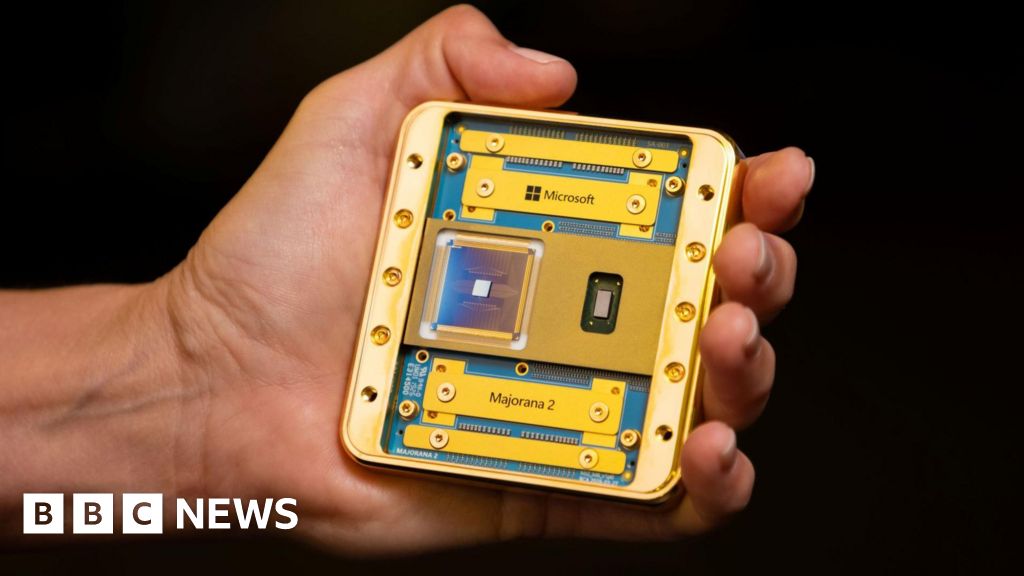
Microsoft says its new quantum chip is much more reliable than its previous version, paving the way for a commercially useful problem-solving quantum computer within three years.
At the heart of quantum computing are qubits, which offer the promise of answering questions that defeat today's machines, but are notoriously delicate and unstable.
Microsoft says the qubits in Majorana 2, its new chip, survive an average of 20 seconds, instead of the milliseconds of Majorana 1.
That means the new chip is 1,000 times more reliable – a performance improvement the tech giant likens to the difference between a phone that needs to be charged every day and one that needs to be recharged every few years.
“We will have a quantum machine in 2029 that can solve reasonable, commercially viable problems,” said Zulfi Alam, vice president of Microsoft Quantum.
This would still require enormous progress, as such a device would require millions of qubits – the current chip, Alam said, has 12.
Assessing the company's claims is difficult because it does not publicly disclose the full details of what it discovered, citing commercial confidentiality.
There is a global race to develop this technology, given its potential to accomplish tasks currently considered too enormous for even the most powerful traditional computers.
Microsoft has spent 20 years pursuing a so-called “topological” approach to quantum computing.
The company's approach relies on exploiting the properties of a quasi-particle, which has only existed in theory since it was first predicted in the 1930s by Italian physicist Ettore Majorana.
To do this, it was necessary to exploit a new state of matter, different from the three familiar states: liquid, solid or gas.
Paul Stevenson, a physics professor at the University of Surrey, said the tech giant's timeline seemed plausible - if its research lived up to its claims.
“Microsoft appears to have taken a big step forward in its attempt to produce viable topological qubits,” he said.
“If they succeed, they will go from being a player without a production quantum computer to being a serious player in the race to build the next generation of fault-tolerant machines.”
False start
Microsoft's focus on topological qubits has sometimes been controversial.
But he continued working on it and his first Majorana chip was launched in 2025.
Henry Legg, a physicist at the University of St Andrews, told the BBC at the time that in his view Microsoft's quantum research had "moved firmly away from science and into the realm of faith".
Today, Jason Zander, executive vice president of Microsoft Quantum and Discovery, said: “We support it 100%.
"We're really looking for scientific rigor. We welcome the debate that has always been part of physics...the key thing I would say to people, go read the papers and look at what's out there, go talk to the experts who we've given in-depth information to."
Microsoft is part of the latest stage of a quantum development program led by US defense research agency Darpa, which aims to "verify and validate the company's large-scale quantum computer concept" and says it has shared all of its data and work with it, including commercially sensitive hardware, for evaluation purposes.
But a paper published alongside the announcement was not peer-reviewed - a process in which it is examined by independent experts - and the scientists the BBC spoke to wanted more information.
The second generation of the Majorana chip is based on the same principles as the first but is more efficient in part because scientists replaced aluminum with lead as the superconductor.
While the team is using AI to try to improve and speed up its efforts, Zander said it was human scientists who came up with the idea of changing the materials.
The qubit dilemma
Microsoft's hoped-for timeline raises the possibility that its quantum computers will tackle problems that could take decades to solve, such as eliminating microplastics or developing better fertilizers for food production.
Zander said he could see a role for humans, AI and quantum computers.
“If you're looking at permanently eliminating chemicals, getting rid of microplastics, things like that, those are traditional things, if we take 15, 20, 30 years to figure it out, that's a very long time,” he said.
“We want to compress that time cycle as much as possible, and so being able to allow humans with AI to act faster and compress that time frame, I think is really cool.
"So it's not about eliminating humans, it's about giving them tools that can help them speed up this process, that's actually going to help society, I think."
But slowing down this process constitutes the fundamental difficulty of quantum computing.
Qubits are extremely fragile and even tiny temperature changes or a small vibration can affect them and cause errors.
Maintaining them for longer is a major challenge for the entire quantum industry.
Quantum machines are in their infancy, and while many companies are working to build a scalable computer, no one has succeeded yet.
Some also think that we may have given up on today's computers too soon.
"We don't know what the limit [of classical computers] is," Sir Demis Hassabis, co-founder of Google Deepmind, recently told author Sebastian Mallaby in the book The Infinity Mind.