- Published on
Military communications have an unusual enemy. One flash and the signal stops
- Authors

- Name
- aimode.news
- @aimode_news
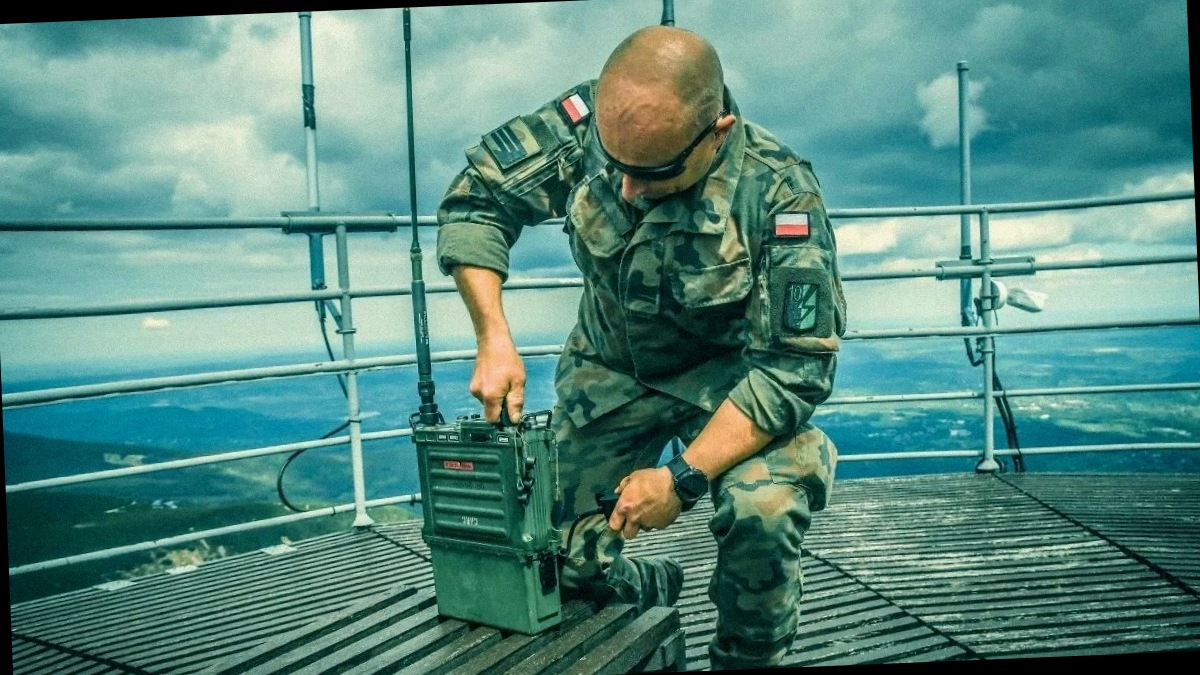
Military communications may fail not only in terms of disrupting the enemy. Sometimes difficult terrain, violent weather or solar activity is enough to change the conditions for the propagation of radio waves. Soldiers of the 10th Wrocław Communications Brigade trained on Śnieżka, where military radio stations had to face one of the most demanding places in Poland.
Soldiers from the 10th Wrocław Communications Brigade trained there, together with specialists from IMWM, in maintaining connections with the parent unit in Wrocław. The task may sound simple, but it really isn't. A radio signal in the mountains has to cope with terrain obstacles, reflections, attenuation and places where the waves reach poorly or hardly at all.
This is the so-called Shadow zones are one of the biggest problems. They are created where the terrain obstructs the direct signal path. A mountain, ridge or structure may cause a radio station to work well on one side of an obstacle and suddenly lose stability on the other side. Then the mere modernity of the equipment will not be enough. You need to be able to choose the frequency, antenna, position setting and working method.
The sun can also disrupt communication. And even very much so
Not only the terrain was important during the training, but also space weather. It concerns, among others, solar flares, solar wind, geomagnetic storms and changes in the ionosphere, the upper layer of the atmosphere where solar radiation knocks electrons out of atoms and molecules, creating an environment that influences the propagation of radio waves.
This is of enormous importance for military communications, especially in bands used for long range. A solar flare is a violent release of energy in the Sun's atmosphere. When strong radiation reaches Earth, it can increase ionization on the illuminated side of the planet. As a result, some radio waves are absorbed more strongly and HF communications may deteriorate or temporarily disappear.
HF, i.e. high frequency, is the short wave range. Its advantage is the ability to communicate over long distances thanks to reflections from the ionosphere. The same ionosphere that normally helps with communications, however, can become a problem during strong solar activity. When conditions change, a previously stable connection may begin to drop out, become noisy, or require switching to different frequencies.
Why do soldiers need to understand signal physics?
A modern army cannot assume that communications will simply work. Digital radio stations, encryption, automatic procedures and modern antennas are a great convenience, but they do not free the operator from thinking. The signal still obeys the laws of physics. It can be weakened by terrain, weather, disturbances, atmospheric conditions and solar activity.
The training with the participation of IMWM specialists made sense. Soldiers could combine radio practice with knowledge about the atmosphere and space weather. A solar flare, solar wind or changes in the ionosphere are not unrealistic abstractions for a communications specialist. These are factors that may determine whether the report goes through on time.
Śnieżka showed problems that are not visible in the barracks
The greatest value of such training is, above all, the confrontation of the equipment with the real environment. In the barracks you can learn procedures, radio operation and standard settings. In the mountains you have to react to what is happening here and now. If the signal weakens, the operator must decide whether to change the frequency, move the antenna, look for another location, adjust the power or change the way of working.
In high mountain areas there is also diffraction. This is the phenomenon of waves bending on obstacles. Thanks to it, the signal sometimes reaches where the straight line between the antennas is obscured, but it does not always do it strong and stable enough. There are reflections, dropouts and local differences in connection quality. For a soldier, this means that two places located several dozen meters apart may provide completely different working conditions.
Read also:
In military communications, operator experience is still very important. A digital radio can provide many suggestions, but it cannot replace a human who understands the terrain, can read a map, assess obstacles and predict where the signal will have a greater chance of passing.
*Source of the introductory photo: 10th Wrocław Communications Brigade