- Published on
Samsung showed what Micro RGB and OLED can do. Sound and image like never before
- Authors

- Name
- aimode.news
- @aimode_news
The Polish premiere of the Samsung AI TV 2026 line was definitely closer to the latter category - although there were also moments when corporate enthusiasm had to be confronted with reality on its own.
Before we entered the room
The format of the event was organized as a workshop, which immediately distinguished it from a typical press conference, where a person sits in a room, receives a presentation and a piece of paper with a logo. The approach was different here: the opportunity to actually spend time in front of the TV, switch sources, experiment with settings and ask questions to brand representatives. This is always a better scenario than a sterile slide presentation - and honestly, it must be said that Samsung has squeezed quite a lot out of this format.
Read also:
In the background: this year, the company celebrates exactly 20 years of being the world's TV market leader. Omdia's data for February confirms this and Samsung does not miss the opportunity to remind about it. An anniversary is always a good excuse to expand the product range, and this year's offer is probably the widest in the brand's history: Micro RGB, OLED in four versions, Neo QLED, Mini LED, The Frame and The Frame Pro. From 42 to 115 inches. There's a lot to choose from - and a lot to write about.
Micro RGB: when LCD plays on OLEDs
The star of the day was - at least in the organizers' mind - a TV with Micro RGB technology. And it's hard to deny that he deserves the most attention. Samsung calls this technology a "new class of LCD TVs," but that phrase doesn't quite convey the importance of what's going on here.
Traditional LCD TV backlighting is one common layer of white light behind the panel, which filters then try to convert into colors. Micro RGB turns this scheme upside down: instead of white LEDs, we have microscopic RGB diodes - separately red, green and blue - placed behind the matrix. Effect? Precise brightness and color control almost at the pixel level, which translates into a color gamut covering the BT.2020 standard to an extent that classic LCD could only dream of. In gaming and HDR movies, this difference is really felt in real life.
The R95H series is available in sizes 65, 75, 85 and 115 inches, and the cheaper R86H starts at 55 inches. The Micro RGB AI Pro processor is designed not only to scale content using neural networks, but also to constantly calibrate the operation of the RGB backlight. The "Safety for Eyes" and "Circadian Rhythm Display" certificates awarded by the VDE (Verband Deutscher Elektrotechniker) are something Samsung boasts about the R95H - and indeed, these are awards granted by an independent, renowned research institute based in Germany, they are not just internal marketing stickers.
At the workshop, you could see this technology in direct comparison with OLED. Black is of course different - Micro RGB is still LCD, so it won't beat the absolute blacks of OLED. But what it does with colors and brightness while maintaining a matte panel with Glare Free is impressive. With HDR content, especially dynamic content - sports, action movies - this TV can fight OLED in its own backyard.
OLED in four flavors: from the living room to the gaming cave
Samsung has prepared four OLED series for this year: S99H, S95H, S90H and S85H. This is an important change compared to previous years and a reasonable move - each model is clearly aimed at a different group of recipients.
The S99H flagship is the one you can stay with the longest. FloatLayer Design allows you to mount the TV flush with the wall - the effect is truly spectacular, especially when wallpaper mode or Art Store mode is activated, with works from over 5,000 galleries and museums. But what really stands out about the S99H from the rest of the pack is the One Connect Wireless Module placed up to 10 meters from the TV, which eliminates cables from around the screen. In practice: the TV itself on the wall has no cable other than electricity.
The S95H model is a proposition for those who like both cinema and games. According to Samsung, OLED HDR Pro offers up to 70 percent. greater brightness than the previous OLED HDR+, and Object Following Sound Plus (OTS+) with a 4.2.2-channel system can actually be felt with dynamic content. However, a four-channel soundstage with 4.2.2 on the TV is something that should be exercised with restraint - the effect depends very much on the acoustics of the room and without a soundbar you still can't beat an external audio system.
The most gaming model in the OLED family is the S90H. 165 Hz Motion Smoother, Nvidia G-Sync and AMD FreeSync Premium Pro is a set that, in theory, places it among the absolute top TVs for gamers.
The S85H model closes the ranks of OLEDs with the NQ4 Gen2 processor and Contour Design - the streamlined, wavy form hides simpler technology than its older siblings, but gives access to OLED technology at a significantly lower price. FreeSync Premium and G-Sync are there, black levels are consistently excellent, as is the case with OLEDs.
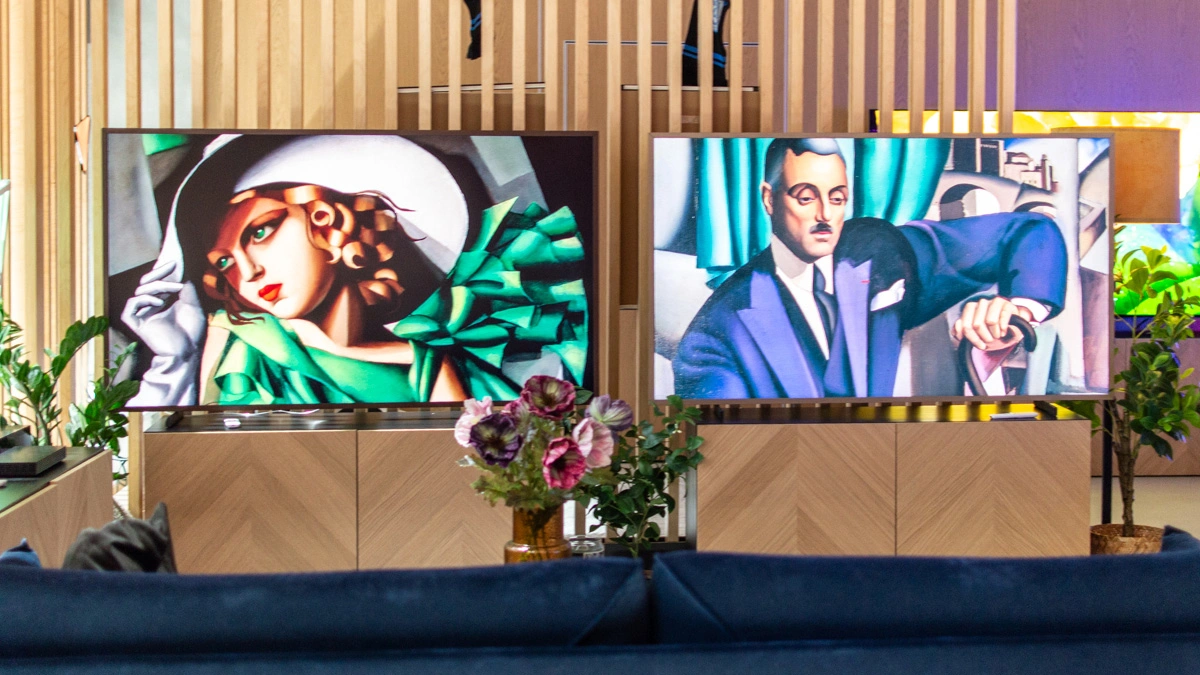
The Frame and The Frame Pro: when your TV wants to be a picture
Not everyone buys a TV to play games or watch movies in cinema mode with the lights off. The Frame is Samsung's answer to those who care most about aesthetics and what the device looks like when not in use.
The Frame Pro (LS03HW) is only 24.9 mm thick and is made with attention to detail that really catches the eye. The One Connect wireless module, Neo QLED with Pantone Validated ArtfulColor certificate and the Glare Free matte matrix make it a proposition that makes sense not only as a lifestyle gadget, but as an actually good TV. Tests of The Frame Pro from the previous generation indicated a brightness of up to about 1000 nits and a significantly better contrast than in the standard Frame - thanks to the zoned local dimming of the Mini LED. Refresh rate up to 144 Hz makes it suitable for occasional gaming without any shame.
The basic The Frame (LS03HE) remains the solution for those for whom installation and minimalism are more important than the highest image parameters. The 43-inch variant has a built-in One Connect module and - note - there is no refresh rate up to 144 Hz, which must be noted when purchasing. The Art Store with over 5,000 works from the world's leading galleries and museums is a function where you can spend a really long time in the workshop, clicking through subsequent exhibitions.
Neo QLED and Mini LED: the foundation of the offer
If flagship technologies are fireworks, then Neo QLED and Mini LED are the sure middle of the offer that sells the best and reaches the largest number of homes.
QN80H is the best-equipped Neo QLED in this year's line. The NQ4 Gen2 AI processor with 20 neural networks upscales content up to 4K, rear zone backlighting gives precise contrast control, and 144Hz Motion Softener and Dolby Atmos support along with AMD FreeSync Premium Pro and Nvidia G-Sync Compatible make it a solid choice for both filmmakers and gamers. Four HDMI 2.1 ports with 4K/144 Hz support are something that previous Neo QLED models lacked.
The cheaper QN74H brings Quantum Mini LED technology to a slightly wider audience, with an NQ4 AI processor and 60 Hz Motion Smoother. This is a compromise that Samsung honestly communicates: fewer local dimming zones, but still better contrast than classic IPS or VA without Mini LED. The Mini LED M80H and M74H series follows a similar path: the M80H with the NQ4 Gen2 processor and 144 Hz is a proposition for those for whom Neo QLED seems unattainable in terms of price, and the M74H with the Mini LED 4K processor and 60 Hz Liquidizer is a budget-reasonable option for a family that wants to improve the image quality without resorting to borrowing money.
Vision AI
AI Sound Controller Pro is a tool that divides the audio track into three separate layers: voice, music and sound effects - and allows you to freely adjust the volume of each of them. In practice: you can turn up the announcer during a match or turn down the crowd noise if your child is sleeping next to you.
AI Upscaling Pro powered by 128 neural networks upscales lower resolution content to near 4K quality. It sounds like an old cliché that every TV manufacturer has been repeating for years, but tested in a workshop on low-quality streaming content - the result was truly beyond expectations. Of course, it's not native 4K, but it's impressive.
A separate chapter is AI Soccer Mode, which Samsung presented with obvious pride. The mode automatically detects a football match, enhances colors, dynamizes contrast and strengthens the commentator's voice at the expense of crowd noise - according to your needs. If you are a fan and you have an OLED or Micro RGB, this function makes watching the match something really enjoyable. If you watch Ekstraklasa on a streaming channel with a poor bitrate, AI Upscaling additionally saves the image.
It is worth mentioning that Vision AI works in all 4K TVs from this year's line, and the Tizen system is to be supported with updates for seven years from the premiere. This is a specific promise from the manufacturer - and one of the arguments worth taking into account when making a purchasing decision.
What does all this mean for the buyer?
Samsung did not reinvent television this year, but it consistently and efficiently closed its offer in all segments. Micro RGB is actually something technically interesting - LCD that can compete with OLED in terms of colors and brightness, although the blacks will not win. The OLED series is extensive and diverse. The Frame Pro is finally a decent TV in a nice frame, not a nice frame with an average TV inside. Neo QLED and Mini LED maintain their level and offer more and more for reasonable money.
Vision AI is not a revolution, but an evolution that is starting to make sense in everyday use. AI Sound Controller Pro is a feature you will use regularly. Samsung does AI in TV carefully and - importantly - does not clutter the interface with functions that require a full-time programmer to configure them. This will be appreciated by both enthusiasts and the rest of the family on the couch.
The workshops were well conducted and provided space for real contact with the equipment. Samsung was more willing than usual to ask for opinions instead of just giving monologues. Is this enough to convince you to replace your TV? It depends on the vintage currently hanging on the wall. But one thing is certain: if you are planning a purchase this year, this year's Samsung line deserves to be taken into account - preferably with an independent measurement in hand and without rushing.