- Published on
Steam Machine: everything we think we know about Valve's new console
- Authors

- Name
- aimode.news
- @aimode_news
After years of rumors and a first failed attempt back in 2015, Valve is back at it with the Steam Machine, its cube-shaped desktop console (or PC, depending on how you look at it) designed to bring the entire Steam library to your living room. The company presented it in November 2025 along with the new Steam Controller and the Steam Frame virtual reality glasses, forming its own hardware ecosystem that revolves around SteamOS.
Regarding its launch, however, things are still not going as well as Valve would have wanted. The global RAM and component crisis has disrupted their plans, delaying both the price and the final date. Despite this, the machinery is already in motion, because at least we already have the Steam Controller on sale and, according to the latest update from Valve, the console is scheduled for release this summer. Below these lines we tell you everything that is known to date about the Steam Machine.
Table of Contents (8)
The Steam Machine is not a regular console, but a compact cube-shaped PC that runs SteamOS, Valve's operating system based on Linux. The idea is that it works like a console (you plug it into the TV, take the controller and play), but with the flexibility of a computer underneath.
It is, in essence, the older desktop sister of the Steam Deck. In fact, Pierre-Loup Griffais, SteamOS developer, compared the experience to playing on a Steam Deck connected to the dock, only with much more graphical muscle. Valve estimates that the Steam Machine offers about six times the power of the Steam Deck.
Unlike the 2015 attempt (which depended on external manufacturers and never caught on), this time Valve has developed everything in-house: hardware, software and accessories.
This has been the great unknown for months. When it was announced in November 2025, Valve was talking about an "early 2026" release window for all three devices. However, the component crisis forced the company to be more cautious, starting to talk first about the "first half of 2026."
However, Valve has calmed the waters and in an official publication on Steam they assured that both the Steam Machine and the Steam Frame will arrive this summer of 2026. It did so by expanding its Verified program to include both devices, where the company itself stated that the two devices will go on sale during the summer.
The Steam Controller was ahead of the rest and hit the market on May 4, 2026 for 99 euros. Valve decided to launch its controller first, in part, to not force PC users to wait for the console and, as explained by Steve Cardinali, the company's hardware engineer, because the controller does not depend on RAM, which is strangling the production of the rest of the catalog.
Valve has not yet announced an official price, and the reason is directly linked to the memory and storage crisis. The company has acknowledged that the escalation in component prices has precisely delayed the confirmation of the cost.
What Valve has dropped is its pricing philosophy. And the idea is to be in the range that it would cost to assemble a PC in parts with equivalent performance. In the initial presentation it was estimated that, due to the components it includes, the console could cost around $700. The problem is that, since then, DRAM prices have skyrocketed by more than 170% year-on-year, as the VGC media recalled, which makes it difficult to maintain any previous figure.
Added to this is information from journalist Mike Straw, from Insider Gaming, who suggests that Valve has been internally debating the price and whether it would be willing to sell the device at a loss, at least in the short term. There will be two models depending on storage (512 GB and 2 TB), so a price range is foreseeable. Likewise, any number should be taken with caution until the official announcement.
Inside, the Steam Machine features custom-designed AMD hardware. These are the specifications that Valve has confirmed:
- CPU: Semi-customized AMD Zen 4 with 6 cores and 12 threads, with a frequency of up to 4.8 GHz and a TDP of just 30 watts.
- GPU: semi-customized AMD RDNA 3 with 28 computing units (CU) and sustained clock frequency up to 2.45 GHz, accompanied by 8 GB of GDDR6 VRAM.
- RAM memory: 16 GB of DDR5 (independent of VRAM, unlike the unified memory of the Steam Deck).
- Storage: NVMe SSD in 512 GB or 2 TB versions, expandable via microSD slot. The SSD goes in an M.2 slot accessible in the base.
- Performance goal: 4K at 60 FPS relying on AMD's FSR scaling, with support for ray tracing.
- Cooling: a single 120 mm fan.
- Power: source integrated into the chassis, without external thief.
Regarding its positioning, it is advisable to moderate expectations. Valve said that the console will have the price of an entry-level gaming PC, avoiding selling it as a graphical beast. Its advantage over the current generation of consoles is in the architecture, since Zen 4 and RDNA 3 are much more modern than the Zen 2 and RDNA 2 that the PS5 and Xbox Series have. The route designed for 4K, however, involves generating the image at an internal resolution close to 1440p and scaling it using FSR, rather than moving that resolution natively.
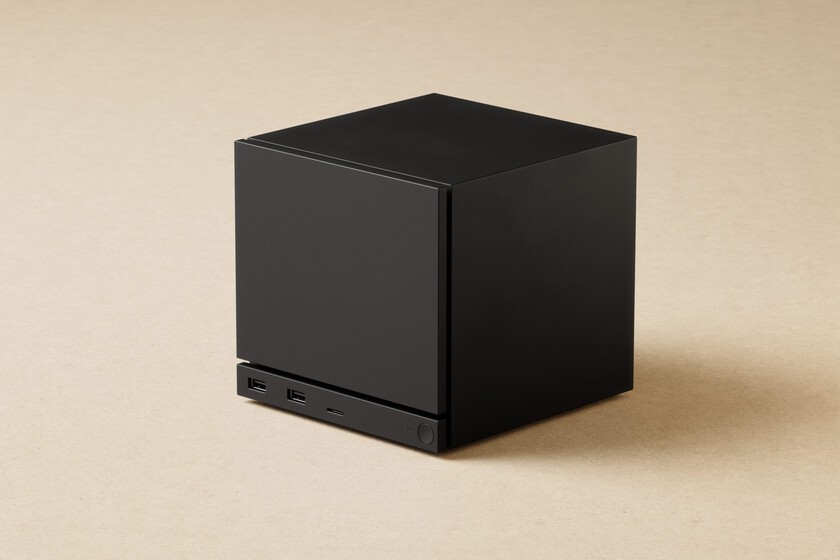
The Steam Machine is a compact black cube that measures approximately 156 x 152 x 162 mm and weighs about 2.6 kg, designed to go unnoticed under the television.
On the front it includes a customizable removable plate and a configurable LED strip, in addition to the USB-A ports and the microSD slot. Video, network and power connectivity is concentrated behind it, next to the fan grill. According to GamersNexus, this front plate is made of magnetic plastic and is easily removed to improve air flow; Valve's idea is even that users can print their own personalized plates.
The list of ports is as follows:
- Video outputs: DisplayPort 1.4 (up to 4K at 240 Hz or 8K at 60 Hz) and HDMI 2.0 (up to 4K at 120 Hz, with CEC).
- USB: two USB-A 3.2 Gen 1 on the front, two USB-A 2.0 on the back and one USB-C 3.2 Gen 2 (10 Gbps) on the back.
- Network: Gigabit Ethernet.
- Wireless: Wi-Fi 6E 2×2 and Bluetooth 5.3 with dedicated antenna, plus an integrated 2.4 GHz adapter to pair the Steam Controller without an external dongle.
The big controversy is in HDMI 2.0. And Valve does not include HDMI 2.1 even though the hardware is capable, which may disappoint anyone who wants to connect the console to a high-end television. Although the company boasts of supporting 4K at 120 Hz, that mode only works without HDR (in 8-bit SDR with 4:2:0 chroma subsampling); If you activate HDR, you stay at 4K at 60 Hz. In addition, Valve explained that at the moment some HDMI 2.1 functions such as DSC and ALLM are missing, but that it is working to incorporate them in the future.
The Steam Controller, which as we have mentioned is already on sale for 99 euros, is a profound revision of the original controller. Among its new features are the Hall/TMR effect joysticks (with magnets to resist drift), two trackpad-type touch panels to emulate a mouse, gyroscopic controls, haptic feedback and an autonomy of up to 35 hours.
For the connection, Valve relies on the Steam Controller Puck, its own wireless receiver that the company claims is more stable than Bluetooth and that allows up to four controllers to be paired at the same time. In the case of the Steam Machine, that puck is integrated into the cube itself. The controller also works via Bluetooth or USB-C cable, and is compatible with PC, Mac and Steam Deck.
The Steam Machine runs SteamOS 3, Valve's Linux-based system, much lighter than Windows and optimized for gaming. It includes features such as quick sleep and resume, cloud saving, and compatibility with other digital stores.
Regarding game compatibility, Valve has extended its Verified program (the same seal it uses on the Steam Deck) to the Steam Machine to indicate at a glance how each title works without touching settings. The good news, according to the company itself, is that a game that already performs well on the Steam Deck will work well on the Steam Machine with no extra work for developers. What's more, titles that were somewhat short on the Deck due to CPU or GPU could run smoothly on the console thanks to its greater power, and Valve claims that it is already testing these cases on its own.
There is an interesting nuance regarding the Deck. And since the Steam Machine will connect to large screens, Valve will not require developers to have text readability requirements or specific resolutions for the Verified seal. That means that a game marked as "Playable" on the Deck due to fine print could appear as "Verified" on the Steam Machine.
For our part, we will update this article with all the news that comes about the Steam Machine, its final price and its exact launch date.
Cover image | Valve