- Published on
The government banned phones in schools. Teachers ask: "Should we look in toilets?"
- Authors

- Name
- aimode.news
- @aimode_news
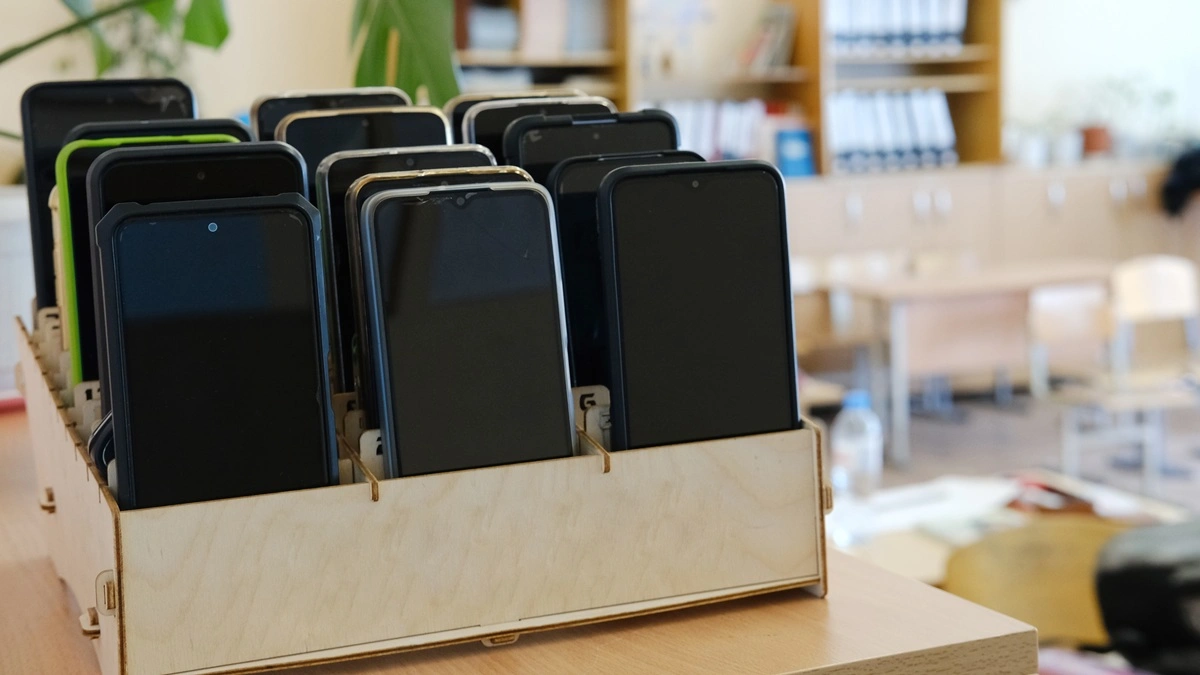
The draft act adopted by the Council of Ministers provides for the introduction of a ban on the use of mobile phones and "other devices enabling distance communication or recording images and sounds - both on school premises and during educational activities outside school" by primary school students. The ban will also apply to non-public primary schools.
- We propose a ban on using mobile phones during classes and breaks in primary schools. This is not a perfect solution, we have no illusions, but we must solve this serious problem of telephone and Internet addiction, admitted the Prime Minister of the Polish government, Donald Tusk.
Not only some parents, but also teachers themselves may agree with the part about this not being an ideal solution. In an interview with the Tricity "Wyborcza", education representatives claim that schools have very limited possibilities to enforce the regulations being implemented.
Principals and teachers notice that answering and returning calls will take a lot of time. If procedures start before the first bell, especially in large schools, students may be late for lessons that start at 8:00. Returning smartphones after classes will mean that the break time will pass.
Storing devices in schools may be a problem
- Where should we keep these phones if we don't have anywhere to put pins? Collecting phones from a hundred children is a real logistical challenge - fears the principal of a primary school attended by almost a thousand students.
For the new regulations to fulfill their role, they must be complied with. And how to make sure that students have not smuggled in smartphones and are not using them during breaks in a corner or in the toilet? Half jokingly, half seriously, we can say that phones will become the new cigarettes, another forbidden fruit.
"Should we look into students' cabins?" - wonders a teacher with 17 years of experience from a school where the ban on using phones has been in force for several years. As she notes, today students take out their smartphones when the person on duty looks away. Therefore, it would be necessary to send several teachers to the school corridors, but it is known that this is impossible to do.
The Ministry of National Education, in response to questions from the Tri-City "Wyborcza", argues that "due to the very large diversity of schools, it is not possible to provide for a specific method of enforcing the ban at the level of the law." Each school should know what will work best for it, the ministry suggests. In some cases, special lockers may be necessary, in others, it is enough for students to put their phones in their backpacks.
The ministry is inconsistent?
The author of the Facebook profile "OKE, i.e. Through the Eyes of a Critical Examiner" noticed an interesting thing. In his opinion, introducing a ban on the use of smartphones by students only in primary schools is illogical.
Because if a phone is harmful to an eighth-grade student, why isn't it harmful to a first-year high school student? If TikTok distracts a fourteen-year-old, why wouldn't it distract a sixteen-year-old? If social media negatively affects young people's concentration and mental health, why should its impact end after primary school? - he asks.
The author of the entry adds that very often older students spend even more time in front of screens than their younger primary school colleagues and use new technologies more intensively.
It is difficult to understand why a smartphone was considered a distraction for a primary school student, but not for a high school or technical school student. After all, reality is exactly the opposite of what this idea suggests (...) If smartphones disrupt learning, they disrupt all students. If they do not bother you, there is no point in banning them. However, the claim that they are a problem only in primary schools is probably one of the most absurd ideas that could be presented in this discussion.
On the other hand, it can be said that in the case of primary schools, this makes particular sense, because we are talking mainly about younger students who can be protected from consequences and alternatives indicated earlier. But then, does this mean that nothing can be done about the habits that older people have developed? I don't think we want to hear that bitter answer.
There are many doubts. Nevertheless, I am of the opinion that something must be done. A ban is not an ideal solution because it alone will not solve the problem. The topic is very complex, non-obvious and difficult. Social media platforms are designed to steal our time and draw us in so that we don't want to put our devices down. If this trap affects adults, young people are especially likely to avoid it. But they often escape from the real world for other reasons - because on the Internet they find friends, people who understand them, passions that absorb them. So are we able to give them something in return? If not, why?
But it is also impossible to ignore the alarming research results on how much time young people spend on the Internet, what they do there, and what dangerous phenomena they encounter - and all this at a very early stage of life.
It would be disastrous if only the ban ended. It won't change anything if the entire environment shows that there is no alternative and that you can only spend your free time in front of screens. And that's often the case. There are many reasons for this situation and there is no one perfect cure.