- Published on
The US has had an idea to reassure Europe. Instead of soldiers, he is going to bring his nuclear weapons very close to Russia
- Authors

- Name
- aimode.news
- @aimode_news
In 1983, tens of thousands of women surrounded a British air base to protest the deployment of American nuclear missiles. That mobilization, known at the time as Greenham Common, became one of the greatest antinuclear symbols of the Cold War and showed the extent to which the location of these weapons could alter European politics.
Less soldiers, more “nuclear”. Europe has been trying for months to decipher what the United States' strategic shift really means. Troop reductions, the withdrawal of some military systems and the increasing priority given to the Indo-Pacific have fueled fears that Washington is progressively moving away from the continent.
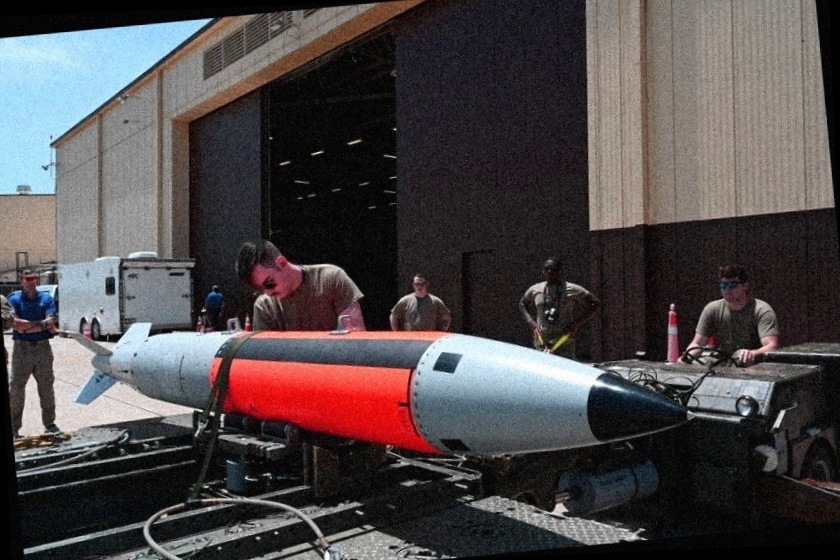
However, conversations within NATO point to a very different response than expected. Instead of reinforcing the conventional presence, the United States would be willing to expand the deployment of nuclear capabilities in Europe to demonstrate that its commitment to the defense of the continent remains intact. The idea is simple but powerful: if there are fewer American uniforms on the ground, the nuclear umbrella must remain visible and credible, even “closer.”
The closer the interest is to Russia. There is no doubt, the allies most interested in this possibility are precisely those who observe Russia from the front line. Poland has been at the top of the list of candidates to host US nuclear capabilities for years, and some Baltic countries have also shown interest in participating in future deterrence formulas.
The invasion of Ukraine and Putin's continued references to his nuclear arsenal have profoundly changed the perception of security in Eastern Europe. The Financial Times recalled that, for these countries, hosting aircraft capable of using US nuclear weapons would have enormous political and military value, since it would turn any threat against them into an issue directly linked to Washington's strategic credibility.
The legacy of the Cold War. The proposal does not involve creating a new system, but rather expanding a mechanism that has existed for decades. Currently Belgium, Germany, Italy, the Netherlands, Turkey and the United Kingdom participate in NATO's nuclear sharing program, through which they store US nuclear weapons under the exclusive control of Washington and train their air forces to operate within that scheme.
This model was born during the Cold War to guarantee that European allies could participate in the Alliance's nuclear strategy without having to develop their own atomic weapons. More than half a century later, the formula is once again gaining prominence in a continent that watches with concern the deterioration of the relationship with Moscow.
Europe seeks to replace some capabilities, but not others. European capitals have assumed that they will have to spend more on defense and rebuild conventional capabilities that they delegated to the United States for decades. From anti-missile systems to strategic transportation to military intelligence, much of the current conversation revolves around how to fill those gaps.
However, there is one area that many governments consider impossible to replace in the short term: the US nuclear deterrent. Although France and the United Kingdom have their own arsenals, Washington's umbrella continues to be perceived as the central element of the European security architecture and as the ultimate guarantee against any military escalation.
The signal that Washington wants to send. They reported in the Times that for now there is no final decision and the conversations remain highly confidential. Still, the mere fact that the possibility is on the table reveals how Western strategy toward Russia is changing. For years the US military presence in Europe was measured in bases, brigades and deployed troops.
Now the discussion increasingly revolves around another type of message. As Washington concentrates resources in Asia and requires its allies to assume a greater share of the defensive effort, the signal it seeks to convey is that nuclear protection remains intact. In a way, the new formula to reassure Europe is not to bring more soldiers closer to Russian borders, but to bring closer what has served for decades as the last guarantee of security: American nuclear weapons.
Image | Air Force, SJOERD HILCKMANN
In Xataka | To become technologically "independent" from the US, the European Union already has a plan: four desperate measures