- Published on
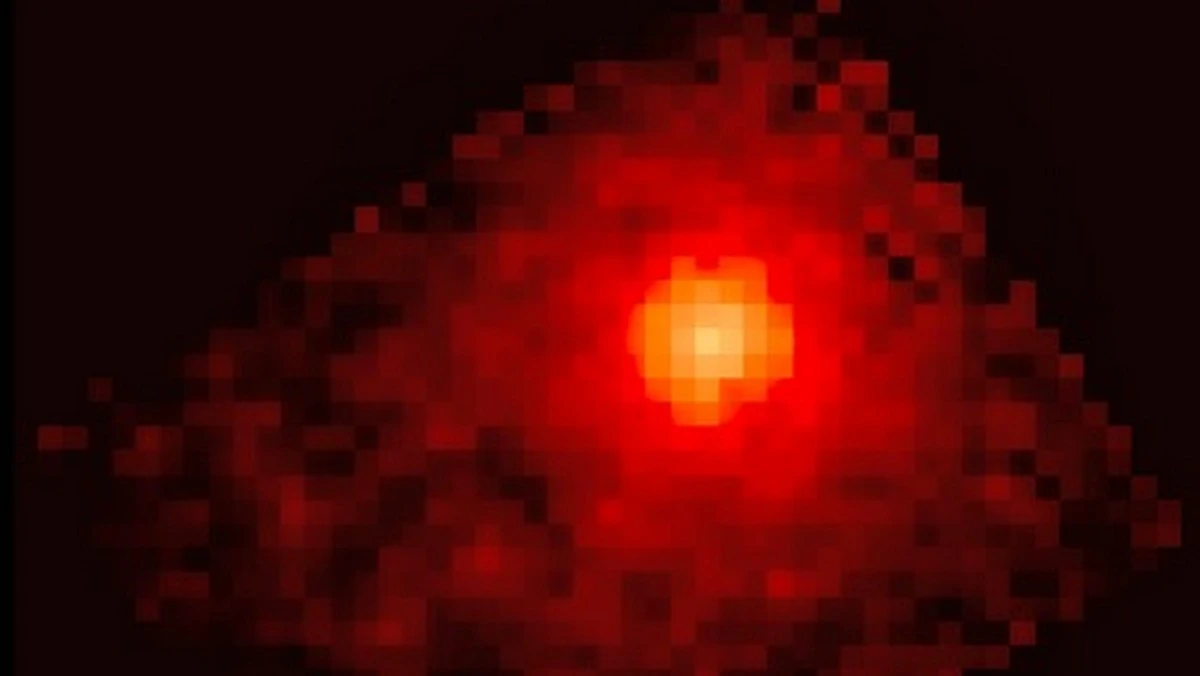
We see the inside of comet 3I/Atlas. The first such case in history
- Authors

- Name
- aimode.news
- @aimode_news
The solar system is visited from time to time by guests from the farthest corners of the galaxy. Interstellar objects, as we are talking about them, travel for millions of years before they accidentally pass by Earth. For astronomers, this is the only opportunity to study the chemical composition of celestial bodies formed around other stars, without having to send probes on centuries-long missions. The latest target of such research is the interstellar comet 3I/Atlas, and the James Webb Space Telescope is the tool that allows us to look into its structure.
Comet 3I/Atlas is only the third confirmed interstellar object to be spotted in our solar system. For the first time, the James Webb Space Telescope directly detected methane when observing such an object. Metan is highly volatile, which means it sublimes very easily from solid ice into a gas.
Methane hidden under the surface
Its delayed appearance in Comet 3I/Atlas suggests that it was hidden beneath the comet's upper surface layer and protected from sublimation until heat from the comet's close flyby of the Sun reached the deeper layers of the icy subsurface. The study results were published in The Astrophysical Journal Letters.
The amount of methane found relative to water is surprisingly high, and there are few similar equivalents in our solar system.
Webb's observations also confirmed that comet 3I/Atlas still has an unusual carbon dioxide content and releases significantly more carbon dioxide relative to water compared to typical solar system comets.
These two key discoveries, excess methane and high carbon dioxide concentrations, provide solid evidence that 3I/Atlas was born in completely different conditions than objects in the Kuiper belt or Oort cloud. The chemistry of its home planetary system must have been based on different proportions of elements, and the comet's formation probably took place at much lower temperatures.
More on Spider's Web:
A comet from another world
Additionally, the James Webb Space Telescope observed a sharp decline in gas production as Comet 3I/Atlas moved away from the Sun, with the decline most pronounced for water. Scientists expected such a scenario for such an object - the less heat the comet receives from the Sun, the colder its surface becomes and the less ice evaporates. Water, which is less volatile than methane or carbon dioxide, shuts down gas production more quickly.
The James Webb Space Telescope observed comet 3I/Atlas using the Mid-Infrared Instrument (MIRI) spectrometer, a powerful instrument designed to break infrared light into its component wavelengths.
This spectrometer is an integral unit of the telescope that generates a spectrum at every point in a small section of the sky, allowing the team to simultaneously measure the presence of gases and visualize their distribution around the comet's nucleus.
The observations were made as the comet was leaving the Solar System after a rapid pass around the Sun (after perihelion). The first observation took place on December 15-16, when the comet was approximately 329 million km from the Sun. The second observation was made on December 27, when the comet was approximately 379 million km from the Sun.
Studies of comet 3I/Atlas show what a powerful tool the James Webb Space Telescope is. Without leaving our orbit, we are now able to study material samples from star systems that humanity will probably never reach.