- Published on
While the West searches for mines, China has built something more difficult to copy: university degrees dedicated to rare earths
- Authors

- Name
- aimode.news
- @aimode_news
The West is clear about breaking China's dominance over rare earths. But the challenge is not only that, but that Beijing has been cultivating a pool of specialists trained from the university for decades. And according to a Reuters investigation, the country has built an entire educational ecosystem dedicated to these critical minerals.
What is happening. Every year, several hundred young Chinese study university degrees focused specifically on rare earths, the 17 elements that power many of the advanced devices and technology of our time, from jet engines to electric cars to wind turbines and much more.
Reuters identified at least 11 universities and technical centers that offer these degrees, with more than 500 students enrolled per year, in addition to more than 40 specialized laboratories spread across the country. Outside of China, according to the same media, there is no center that offers a specific university degree in rare earths.
Why it is important. China processes more than 90% of the world's refined rare earths and magnets. And apart from mines and factories, people are also needed who know how to extract and separate elements of almost identical chemistry, a technically complex and expensive process. And the advantage of Beijing, in addition to geological and industrial, is that it also has the talent.
In detail. As the media details, a good part of these schools and laboratories are concentrated near the large mines. An example is Baotou, in Inner Mongolia, about 150 kilometers from the largest rare earth deposit in the world. There, the Inner Mongolia University of Science and Technology trains students who receive more than 100 hours of classes in subjects such as rare earth chemistry and materials science, some taught directly in the facilities of companies in the sector.
The industry is so tied to these schools that it is normal for students to start working immediately. "In China, I hired kids straight out of university and they were instantly productive; anywhere else I needed to train them for three years," Constantine Karayannopoulos, former CEO of the companies Neo Performance Materials and Molycorp, told Reuters.
Between the lines. Some universities openly acknowledge that they are forming geopolitical assets. Li Chaozhong, dean of the rare earths program at Jiangxi University of Science and Technology (JXUST), told state television CCTV that these minerals are "essential bargaining chips" in global politics, and that his university's new program also seeks to ensure that China maintains its global leadership in the sector.
JXUST students learn the entire supply chain, from processing and metallurgy to magnets, and work on research projects with companies before graduating.
Contrast with the West. Although the refining of rare earths was a Western domain until the end of the 20th century, the industry practically disappeared from Europe and the United States, and with it specialized training. As the media highlights, mining has never attracted much attention to American students, who often see it as a dirty and old-fashioned sector.
In 2023, US institutions awarded just over 200 general mining engineering and metallurgy degrees. There are specific exceptions, such as the Colorado School of Mines, which is preparing new research centers with the Department of Energy, but little else.
Why is it so difficult to close the gap? In recent years, China has tightened restrictions on the export of technology and equipment for rare earths, and according to sources cited by Reuters, it has limited contact between its technicians and foreigners, going so far as to withdraw passports from some of them. Control was intensified following the "Liberation Day" tariffs announced by Donald Trump in April 2025.
And now what. The United States has begun to make a move, with billions of dollars allocated from 2024 to rebuild its mining experience and legislative proposals to cooperate with allies in formation. The complicated thing is to build a pool of specialists like the one in China. That is something that is not achieved overnight.
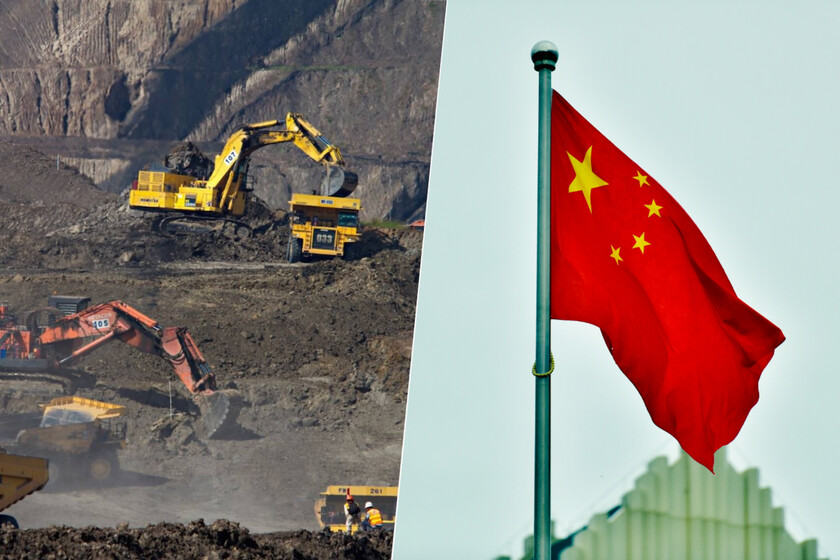
Cover image | Dominik Vanyi and Arthur Wang
In Xataka | The treasure that Europe was looking for in China is in Jaén: rare earth concentrates of 19.4%