- Published on
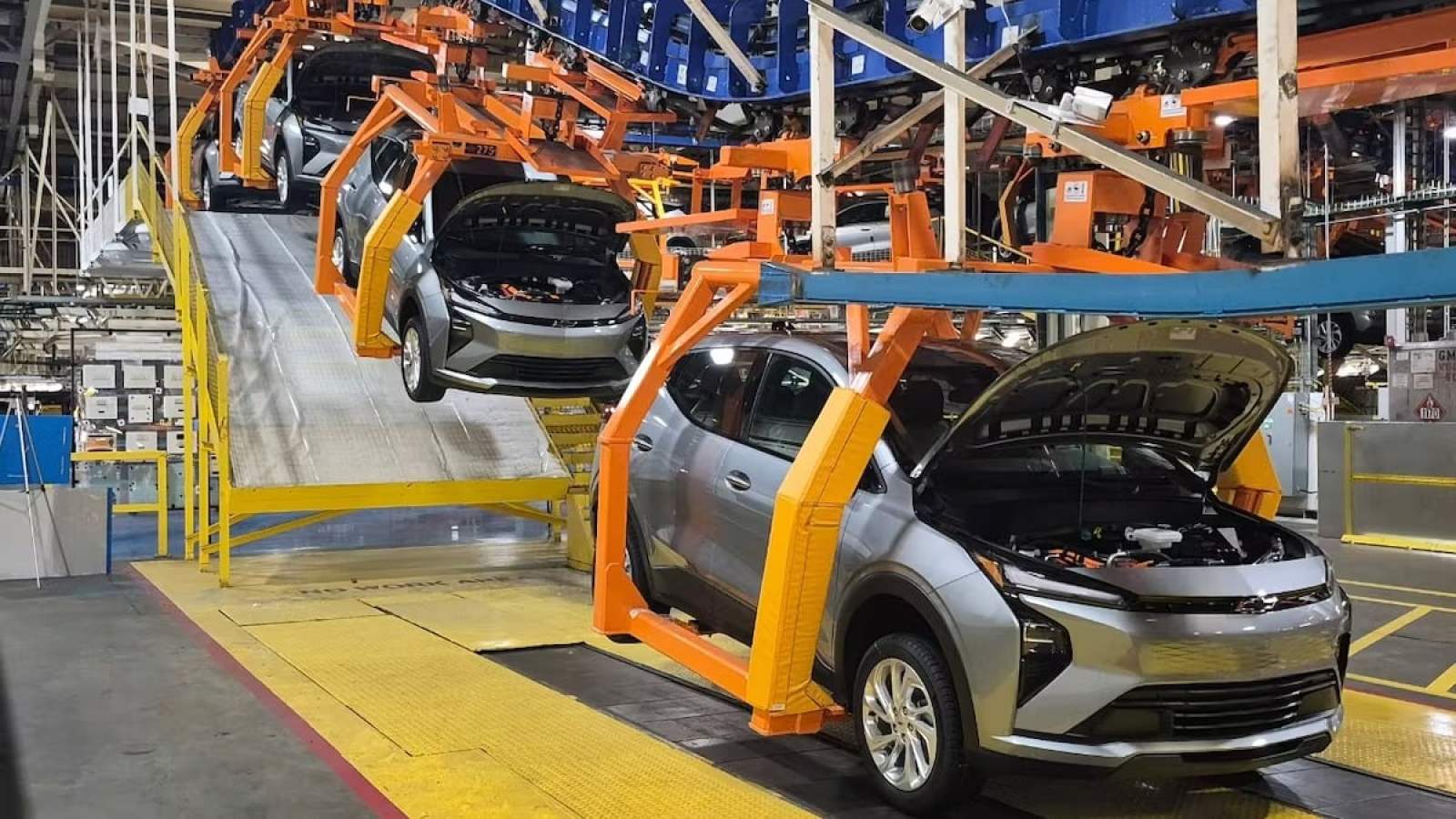
Why General Motors is building its new Bolt EV in batches of 30 at once
- Authors

- Name
- aimode.news
- @aimode_news
For a car manufacturer, it's not all about selling cars. Above all, we must produce them. However, this cannot be improvised, especially in these troubled times, whether for brands or for equipment manufacturers.
Because we know, manufacturing costs are high, and have a direct influence on the price paid by customers. In addition, companies must do everything possible to accelerate the pace as much as possible, in order to reduce delivery times. Many challenges, to which the General Motors group is trying to respond.
And this is how he found a solution that may seem rather surprising, within his factory located in Fairfax, Kansas City (Kansas), in the United States. There, the group notably produces the Chevrolet Bolt, a small electric car. For the record, the current generation was unveiled in October 2025 and marketed in the first quarter of 2026. And the American manufacturer had a surprising, but very clever, idea. He actually produces his compact in batches of 30 copies. But what is the reason?
Well the Automotive News site tells us a little more about it. But it's actually very clever, as Michael Youngs, plant manager in Kansas, reveals. The latter explains that the brand simply asked itself: “How can we guarantee maximum efficiency when launching the Bolt? ". This is how “the concept of batch production was born”. But what does this really consist of? In fact, the idea couldn't be simpler.
Easier logistics
It simply consists of manufacturing 30 strictly identical examples of the car, with exactly the same configuration. And this while the Bolt is available in two finishes (LT and RS), three roof configurations and seven body colors. Which allows for many combinations. But what is the point of this practice? In fact, there are several. First, it makes it easier for suppliers, who can know precisely which models are being produced, and which parts will be needed.
In addition, the paint shop equipment requires less regular cleaning, because the cars are all painted the same color. Finally, operators also spend less time moving “between different batches of parts intended for different vehicles”. This represents a gain in productivity, and therefore savings. At the same time, the factory also keeps a version of each configuration in the event of a problem. This makes it possible to replace a defective vehicle in the chain without interrupting production.
Note that this industrial discipline is reminiscent of what Tesla practices, which also groups together similar productions to limit complexity. The nuance is the approach: where Tesla simplifies the product itself, GM keeps its finishes and options and simplifies the process around it. A difference in philosophy between historic manufacturer and new entrant.
However, expert Sam Fiorani explains that “this type of assembly only works in small series”. And this while Chevrolet currently produces between 2,000 and 3,000 copies of its Bolt per month. But ultimately, this technique could also be adapted for mass manufacturing. This is precisely what the manufacturer plans to do, which now wants to further improve its solution. Because he plans to continue batch production well after the end of the electric compact.